
Certificate in Food Preparation & Production
Master the Fundamentals of Professional Cooking. Build Your Future in the Culinary Industry.

Every successful chef begins with mastering the basics.
The Certificate in Food Preparation & Production at KAGC College equips aspiring chefs with practical skills in professional cooking, food preparation, kitchen operations, and food safety through 70% hands-on training in commercial kitchens. Graduate with a nationally recognised SKM Level 2 qualification and build a strong foundation for a career in the culinary industry.
Graduate in just 9 months with:
- Malaysian Skills Certificate (SKM Level 2)
- 70% Practical Kitchen Training
- Industry Standard Commercial Kitchen Experience
- Professional Culinary Skills Development
- Direct Academic Pathway to Advanced Diploma in Culinary Arts & Gastronomy
- Food Safety & Kitchen Operations Training
Professional Cooking Begins with Strong Fundamentals
Many people believe becoming a chef simply means learning how to cook delicious food.
In reality, professional cooking is very different from cooking at home.
Professional chefs work in fast-paced commercial kitchens where precision, consistency, teamwork, food safety and time management are just as important as creativity. Every ingredient must be prepared correctly. Every dish must meet quality standards. Every service requires coordination between multiple kitchen stations working together under pressure.
Before chefs can lead kitchens, design menus or specialise in international cuisines, they must first master the essential skills that form the backbone of every professional kitchen.
That is exactly what the Certificate in Food Preparation & Production is designed to achieve.
Students begin by learning the foundations of professional culinary practice, including food preparation techniques, knife skills, cooking methods, kitchen hygiene, food safety, ingredient handling and commercial kitchen operations. These practical competencies provide the confidence and discipline required to succeed in the culinary profession.
Rather than memorising recipes, students learn the principles behind professional cooking so they can confidently prepare dishes to industry standards while understanding why specific techniques and procedures are used.
Why Parents and Students Choose KAGC
Choosing the right culinary programme is about more than simply learning how to cook. Parents want assurance that their children will develop practical skills, recognised qualifications and clear career progression, while students want an engaging learning experience that prepares them for real employment.
KAGC College combines practical skills training with structured industry education to help students build a strong foundation before entering the workforce or continuing into higher culinary studies.
Students benefit from:
- Nationally Recognised SKM Level 2 Qualification
- 70% Hands-on Practical Kitchen Training
- Learning in Industry Standard Commercial Kitchens
- Guidance from Experienced Culinary Professionals
- Realistic Kitchen Simulations and Practical Assessments
- Strong Foundation for Hotel, Restaurant and Catering Careers
- Clear Academic Progression into Advanced Diploma in Culinary Arts & Gastronomy
Program Highlights
Duration
9 Months
Learning Approach
70% Practical Learning
30% Theory
Qualification
UK Advanced Diploma + SKM Level 2 Certification
Language Medium
English & Mandarin
About The Programme
Malaysia's food and hospitality industry continues to grow as restaurants, hotels, cafés, bakeries, catering companies and food service businesses seek skilled culinary professionals who understand both cooking techniques and professional kitchen operations.
The Certificate in Food Preparation & Production has been developed to prepare beginners for this exciting industry by focusing on the practical skills required in commercial kitchens.
Throughout the programme, students progressively develop competencies in:
- Professional Knife Skills
- Food Preparation Techniques
- Kitchen Organisation
- Food Safety & Hygiene
- Stocks, Soups & Sauces
- Local & Western Cooking
- Meat, Poultry & Seafood Preparation
- Vegetable Preparation
- Breakfast Production
- Basic Desserts
- Commercial Kitchen Operations
- Teamwork & Professional Kitchen Communication
Students also learn the importance of discipline, consistency, cleanliness and time management—qualities highly valued by employers across the hospitality and food service industry.
Unlike home cooking, commercial kitchens require every dish to be prepared consistently regardless of who is cooking. Students therefore develop an understanding of standard operating procedures, quality control, portion consistency and safe food handling practices that meet professional industry expectations.
By the end of the programme, graduates possess the confidence to work in entry-level culinary positions while having the academic foundation to continue into higher qualifications and specialised culinary training.
Learn by Doing. Build Skills Like a Professional Chef.
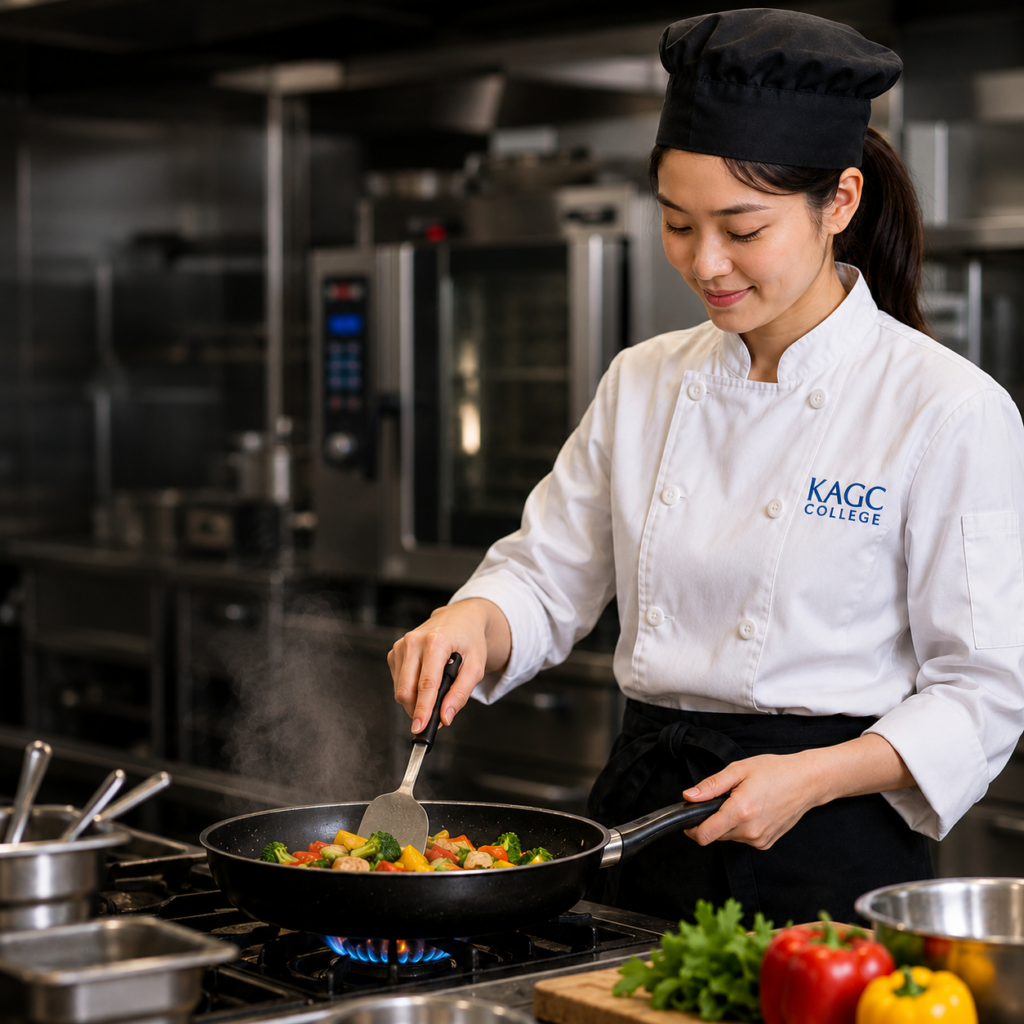
Professional chefs develop their expertise through continuous practice, not by simply reading recipes or memorising cooking techniques. At KAGC College, students learn in a realistic commercial kitchen environment where every practical session is designed to simulate the standards, pace, and discipline of the food service industry.
With 70% practical training and 30% theory, students progressively develop the technical skills, confidence, and professionalism required to work in restaurants, hotels, cafés, catering companies, and other food service establishments. Each practical exercise reinforces the knowledge learned in class, helping students understand not only how to prepare food, but also why professional techniques and industry standards matter.
Who Should Apply?
This programme is ideal for individuals who are passionate about food and want to begin a career in the culinary industry, regardless of whether they have previous cooking experience.
✔ SPM School Leavers
✔ Students Interested in Becoming Professional Chefs
✔ Beginners with No Culinary Experience
✔ Individuals Passionate About Cooking and Food
✔ Future Hotel and Restaurant Kitchen Professionals
✔ Career Changers Looking to Enter the Food Service Industry
✔ Students Planning to Progress into an Advanced Diploma in Culinary Arts & Gastronomy
✔ Aspiring Food Entrepreneurs Seeking Strong Culinary Foundations
Course Format & Features
✓ Complete the programme in just 9 months
✓ 70% Practical Kitchen Training
✓ 30% Theory-Based Learning
✓ Learn in Industry Standard Commercial Kitchens
✓ No Previous Cooking Experience Required
✓ Nationally Recognised Malaysian Skills Certificate (SKM Level 2)
✓ Practical Assessments Based on Industry Competencies
✓ English & Mandarin Medium
✓ Clear Academic Progression to Higher Culinary Qualifications
What Does 70% Practical Learning Mean?
At KAGC, practical learning means students spend most of their time developing real culinary skills through hands-on activities rather than relying solely on classroom lectures. Every lesson is designed to replicate the daily responsibilities of a professional kitchen, allowing students to gain confidence while building industry-relevant competencies.
Professional Knife Skills
Develop essential knife handling techniques, ingredient preparation methods, and safe cutting practices used in commercial kitchens. Students learn precision, speed, consistency, and proper maintenance of professional kitchen tools.
Food Preparation & Cooking Techniques
Master fundamental cooking methods including boiling, steaming, roasting, grilling, frying, sautéing, braising, and baking. Students understand how different cooking techniques affect flavour, texture, appearance, and nutritional value.
Stocks, Soups & Sauces
Local & International Cuisine
Prepare a diverse selection of Malaysian favourites alongside popular Western dishes. Students develop an appreciation for different culinary traditions while learning proper presentation, portioning, and plating techniques.
Kitchen Operations
Understand how professional kitchens function efficiently through proper workflow, station organisation, mise en place, inventory control, teamwork, and communication. Students learn the importance of discipline and coordination in delivering consistent food quality.
Food Safety & Hygiene
Apply industry-standard food safety practices by learning personal hygiene, cross-contamination prevention, temperature control, safe food storage, sanitation procedures, and workplace safety. These competencies are essential for protecting customers and maintaining professional kitchen standards.
Practical Skills Assessment
Throughout the programme, students demonstrate their abilities through practical cooking assessments, food preparation tasks, kitchen simulations, and competency-based evaluations that reflect real workplace expectations.
What Will You Learn?
| Learning Area | Key Competencies Developed |
|---|---|
| Professional Knife Skills | Knife handling, cutting techniques, ingredient preparation |
| Food Preparation | Vegetable, meat, poultry and seafood preparation |
| Cooking Techniques | Boiling, steaming, grilling, frying, roasting, baking and sautéing |
| Stocks, Soups & Sauces | Preparation of professional culinary foundations |
| Malaysian & Western Cuisine | Preparation, cooking and presentation of complete dishes |
| Food Safety & Hygiene | HACCP principles, sanitation, safe food handling and storage |
| Kitchen Operations | Mise en place, workflow, teamwork and kitchen organisation |
| Food Presentation | Portion control, garnishing and plating techniques |
| Professionalism | Communication, discipline, teamwork and time management |
Learn in a Realistic Commercial Kitchen Environment
Students train in facilities designed to reflect the environment of professional kitchens found in hotels, restaurants, cafés, and catering businesses. Working with commercial kitchen equipment allows students to become familiar with industry practices while developing the confidence to transition into the workplace after graduation.
Learning takes place through demonstrations, guided practical sessions, individual cooking exercises, group activities, and competency-based assessments. This immersive approach enables students to experience the pace and expectations of a real kitchen while receiving continuous guidance and feedback from experienced chef lecturers.
Build a Strong Foundation for Your Culinary Future
The Reality of Progression
Without formal management and fine-dining knowledge, climbing the culinary ladder takes over a decade, if it happens at all. With the KAGC Certificate in Food Preparation and Production, graduates bypass the plateau.
Careers unlocked by this diploma:
- Commis Chef / Demi Chef (Fine Dining)
- Sous Chef / Executive Chef (Fast-tracked)
- Food & Beverage Manager
- Menu Developer / Molecular Gastronomist
- F&B Entrepreneur / Restaurateur
Industry Recognition
Graduates have secured internship and employment opportunities with Michelin-standards F&B establishments and/or leading five-stars hotel group :










WHY CHOOSE KAGC'S CERTIFICATE IN FOOD PREPARATION & PRODUCTION?
Every professional chef starts somewhere.
Before becoming a Sous Chef, Executive Chef or restaurant owner, every culinary professional first learns how to prepare ingredients correctly, cook safely, work efficiently, and perform confidently in a professional kitchen.
KAGC’s Certificate in Food Preparation & Production is designed specifically for beginners who want to build these essential skills through practical learning. Whether you have just completed SPM, enjoy cooking as a hobby, or are considering a career change into the culinary industry, this programme provides the structured foundation needed to begin your journey with confidence.
Rather than focusing only on recipes, students learn the techniques, discipline, and professional standards that employers expect in today’s hotels, restaurants, cafés and catering businesses.
Build Your Culinary Foundation the Right Way
Many people enjoy cooking at home, but working in a commercial kitchen requires a completely different set of skills.
Professional chefs must prepare food consistently, work efficiently under pressure, follow strict food safety procedures, communicate effectively with their team, and maintain high standards of quality throughout every service.
At KAGC, students develop these competencies progressively through practical training in a structured learning environment. By mastering the fundamentals first, students gain the confidence to handle more advanced culinary techniques and workplace responsibilities as their careers grow.
This strong foundation not only improves employability but also prepares students for further studies in culinary arts and hospitality.
Learn Through Practical Experience
Cooking is a skill that can only be mastered through practice.
That is why KAGC adopts a learning approach where approximately 70% of the programme focuses on practical training.
Students spend most of their learning time preparing ingredients, practising cooking techniques, operating commercial kitchen equipment, plating dishes, maintaining hygiene standards, and working as part of a kitchen team.
Instead of simply watching demonstrations, students actively participate in every stage of food preparation while receiving continuous guidance and feedback from experienced chef lecturers.
This practical approach helps students develop confidence, improve technical skills, and become familiar with the expectations of a professional kitchen long before they enter the workforce.
Experience a Professional Kitchen Environment
The transition from home cooking to commercial kitchens can be challenging without proper preparation.
Students train in commercial kitchen facilities that simulate real industry environments, allowing them to become familiar with professional equipment, kitchen workflows, food preparation stations, and workplace procedures.
Throughout the programme, students learn how professional kitchens operate efficiently by understanding mise en place, kitchen organisation, teamwork, communication, time management, and quality control.
These workplace habits become second nature through regular practice, making graduates better prepared for employment after completing the programme.
Learn From Experienced Culinary Professionals
A great culinary education is guided by experienced mentors.
At KAGC, students learn from chef lecturers who bring valuable industry experience into the classroom. They share not only cooking techniques but also practical insights into kitchen operations, workplace expectations, and professional standards developed through years of working in the food service industry.
Students receive personalised guidance throughout their practical training, helping them improve their technical abilities while developing the confidence and professionalism required in commercial kitchens.
Learning directly from experienced professionals allows students to avoid common beginner mistakes and better understand the realities of working in the culinary industry.
Earn a Nationally Recognised Qualification
Upon successful completion of the programme, students are awarded the Malaysian Skills Certificate (SKM Level 2), issued under Malaysia's national skills qualification framework.
The SKM qualification demonstrates that graduates have achieved industry-recognised competency standards in food preparation, cooking techniques, kitchen operations, and food safety.
Because it is recognised by employers throughout Malaysia, the qualification provides graduates with greater confidence when applying for positions in hotels, restaurants, cafés, catering companies, institutional kitchens, and other food service organisations.
For many students, this qualification also serves as the first step towards higher-level culinary education and long-term career development.
ACADEMIC PARTNER
Earn a Nationally Recognised Malaysian Skills Certificate (SKM)
The Certificate in Food Preparation & Production is accredited under Malaysia’s National Occupational Skills Standard (NOSS) and leads to the award of the Malaysian Skills Certificate (Sijil Kemahiran Malaysia – SKM) Level 2.
The SKM qualification is issued by the Department of Skills Development (Jabatan Pembangunan Kemahiran, JPK) under the Ministry of Human Resources and is widely recognised by employers across Malaysia. It certifies that graduates have demonstrated competency in practical culinary skills based on nationally established occupational standards.
Unlike programmes that focus primarily on academic examinations, the SKM framework emphasises hands-on competency, ensuring graduates possess the practical skills required to perform effectively in real workplace environments.
For students who wish to continue their education, the SKM pathway also provides opportunities to progress into higher-level skills qualifications and advanced culinary programmes, supporting continuous professional development throughout their careers.
Why an SKM Qualification Matters
Choosing an accredited skills qualification gives students more than just a certificate—it provides a recognised pathway into Malaysia’s growing culinary and hospitality industry.
By completing this programme, students gain:
- A nationally recognised Malaysian Skills Certificate (SKM Level 2)
- Competency-based training aligned with industry requirements
- Practical skills valued by employers in hotels, restaurants, cafés, and catering companies
- A solid foundation for further culinary education and career advancement
- Greater confidence when entering the workforce with recognised technical competencies
Study Financial Support
Quality education should be accessible to every aspiring culinary professional.
To help students and parents manage their education investment, KAGC College offers several financial assistance options, allowing families to choose a payment arrangement that best suits their circumstances.
Available support may include:
- PTPK Education Loan (subject to eligibility and approval)
- Flexible Monthly Instalment Plans
- Early Bird Promotion (where applicable)
- Personalised Admission & Financial Consultation
Our Admissions Team will be happy to guide students and parents through the available funding options and recommend the most suitable financial arrangement based on individual needs.

Entry Requirements
Minimum Requirements
✓ Minimum age: 16 years old
✓ Completed SPM or equivalent qualification
✓ School leavers and working adults are welcome
Intake
January
May
July
October
Required Documents
✓ KAGC College Application Form
✓ Photocopy of NRIC of the student(front & back)
✓ A certified photocopy of SPM and/or school leaving certificate
✓ A copy of a passport-size photo on white background
✓ A certified copy of your previous qualification to claim for exemption (if applicable)
Frequently Asked Questions
What is the Certificate in Food Preparation & Production?
The Certificate in Food Preparation & Production is a skills-based culinary programme designed for beginners who want to build a strong foundation in professional cooking. Students learn food preparation, cooking techniques, kitchen operations, food safety, and teamwork through 70% practical training in commercial kitchens. Upon successful completion, graduates receive the Malaysian Skills Certificate (SKM Level 2), which is recognised by employers throughout Malaysia.
Who is this programme suitable for?
This programme is ideal for:
- SPM school leavers
- Students who enjoy cooking
- Individuals with no previous culinary experience
- Career changers interested in the food service industry
- Anyone planning to become a professional chef
- Students who wish to continue into an Advanced Diploma in Culinary Arts & Gastronomy
Do I need cooking experience before joining?
No. This programme is designed specifically for beginners. Students start by learning the fundamentals of food preparation, kitchen safety, and cooking techniques before progressing to more advanced practical skills.
What will I learn in this programme?
Students develop practical skills in:
- Professional knife skills
- Food preparation
- Cooking techniques
- Stocks, soups and sauces
- Malaysian and Western cuisine
- Kitchen operations
- Food safety and hygiene
- Food presentation
- Teamwork and communication
What makes this programme different from learning cooking at home?
Home cooking focuses on preparing meals for family and friends, while professional cooking requires consistency, efficiency, teamwork, food safety, quality control, and working under pressure. This programme teaches students the professional standards expected in commercial kitchens.
Is this programme practical or theory-based?
Approximately 70% of the programme consists of practical training. Students spend most of their learning time preparing food, practising cooking techniques, and working in commercial kitchen environments, supported by classroom theory that explains the principles behind professional cooking.
What qualification will I receive after graduation?
Graduates receive the Malaysian Skills Certificate (Sijil Kemahiran Malaysia – SKM) Level 2, issued by the Department of Skills Development (JPK).
Is SKM recognised in Malaysia?
Yes. The Malaysian Skills Certificate (SKM) is a nationally recognised qualification under the Department of Skills Development (JPK). It demonstrates that graduates have achieved industry-recognised competency standards and is widely accepted by employers across Malaysia.
Can I become a chef after completing this programme?
Yes. This programme prepares graduates for entry-level positions in professional kitchens, such as Kitchen Assistant or Commis Chef. As with any culinary career, advancement to senior positions requires additional experience, continuous learning, and professional development.
Can I continue my studies after completing this certificate?
Yes. Graduates may progress to higher-level culinary qualifications, including KAGC’s Advanced Diploma in Culinary Arts & Gastronomy, subject to the institution’s admission requirements.
What jobs can I apply for after graduation?
Graduates may pursue roles such as:
- Kitchen Assistant
- Commis Chef
- Food Preparation Assistant
- Catering Assistant
- Café Kitchen Crew
- Hotel Kitchen Staff
- Restaurant Kitchen Crew
- Central Kitchen Assistant
Which industries can I work in?
Graduates may find opportunities in:
- Hotels
- Restaurants
- Cafés
- Catering companies
- Bakeries
- Resorts
- Food manufacturers
- Cruise ships
- Airline catering
- Institutional kitchens
Will I learn food safety?
Yes. Students learn proper food handling, personal hygiene, cross-contamination prevention, sanitation, temperature control, and workplace safety to meet industry standards.
Will I learn professional knife skills?
Yes. Knife skills are one of the core competencies taught in this programme. Students learn safe handling techniques, cutting methods, ingredient preparation, and knife maintenance.
What types of cuisine will I learn?
Students are introduced to both Malaysian and Western cuisine while learning essential cooking methods that can be applied across different culinary styles.
Will I learn dessert preparation?
Yes. Students learn the fundamentals of preparing simple desserts and understand the role of desserts in professional menu planning.
What facilities will I learn in?
Students train in commercial kitchen facilities equipped with industry-standard equipment to simulate real workplace environments.
How are students assessed?
Assessment is competency-based and includes practical demonstrations, cooking assessments, assignments, and skills evaluations aligned with industry requirements.
Will I receive practical training throughout the programme?
Yes. Practical learning takes place throughout the entire programme, allowing students to continuously build confidence and improve their technical skills.
Is there an internship?
This programme focuses on intensive practical training within KAGC’s commercial kitchens. Students wishing to gain further workplace experience may continue into higher-level programmes that include industry training.
Is this programme suitable for SPM leavers?
Yes. The programme is designed specifically for students who have completed SPM and wish to pursue a practical career in the culinary industry.
Is this programme suitable for adults or career changers?
Yes. Adults who are passionate about cooking or looking for a career change can join the programme even if they have no previous culinary background.
Can I become an entrepreneur after completing this programme?
This programme provides the practical culinary foundation needed for future entrepreneurship. Graduates may eventually pursue opportunities such as opening cafés, food stalls, catering businesses, cloud kitchens, or restaurants after gaining industry experience.
Will I learn teamwork?
Yes. Students work together during practical kitchen sessions to develop communication, coordination, and teamwork—essential skills in every professional kitchen.
Is English proficiency required?
How long does the programme take?
The Certificate in Food Preparation & Production can be completed in 9 months.
What is the learning approach?
The programme follows a 70% practical and 30% theory approach to ensure students gain hands-on experience while understanding the principles behind professional cooking.
Why is practical learning important?
Cooking is a technical skill that improves through repeated practice. Practical learning allows students to develop confidence, refine techniques, and prepare for the pace of commercial kitchens.
Why should I choose TVET instead of a traditional academic programme?
TVET programmes focus on practical skills and industry competencies. Students graduate with hands-on experience that helps them transition more confidently into employment.
Can I work overseas after completing this programme?
The SKM qualification provides a strong foundation for a culinary career. Opportunities to work overseas depend on employer requirements, work experience, language proficiency, and each country’s immigration regulations.
Will I learn kitchen management?
Students are introduced to the basics of kitchen organisation, workflow, communication, and operational procedures, forming a foundation for future management responsibilities.
Why is food safety so important?
Food safety protects customers, maintains food quality, and ensures compliance with industry regulations. Every professional chef is expected to follow strict hygiene and food handling procedures.
Is the culinary industry still a good career choice?
Yes. Malaysia’s hospitality, tourism, restaurant, and food service industries continue to require skilled culinary professionals as demand for quality dining experiences grows.
What qualities make a successful chef?
Successful chefs are passionate about food, willing to learn continuously, disciplined, organised, adaptable, able to work under pressure, and committed to maintaining high standards of quality and hygiene.
Why should parents choose this programme for their child?
Parents choose this programme because it combines practical skills training, nationally recognised certification, experienced chef lecturers, and a clear progression pathway into higher culinary education and long-term career development.
Why should I study at KAGC College?
KAGC College provides practical culinary education through commercial kitchen training, experienced chef lecturers, small practical classes, industry-focused learning, and clear academic progression pathways that prepare students for employment and further study.
What is the difference between this certificate and the Advanced Diploma in Culinary Arts & Gastronomy?
The Certificate in Food Preparation & Production focuses on building foundational culinary skills for beginners, while the Advanced Diploma develops advanced cooking techniques, menu engineering, restaurant management, gastronomy, leadership, and industry training for students seeking higher-level career opportunities.
Can I become an Executive Chef after this programme?
Becoming an Executive Chef requires years of industry experience, continuous professional development, and leadership skills. This certificate provides the essential foundation for that career journey.
Is this programme suitable for students who are unsure about their future?
Yes. Students who enjoy cooking but are still exploring career options can use this programme to discover their interests while developing valuable practical skills that are transferable across the food and hospitality industry.
Why is the Certificate in Food Preparation & Production a good starting point for a culinary career?
Every professional chef begins by mastering the fundamentals. This programme equips students with the practical cooking skills, professional kitchen knowledge, food safety awareness, and workplace confidence needed to begin a successful culinary career or continue into higher qualifications. With a nationally recognised SKM Level 2 qualification and extensive hands-on training, graduates are well prepared to take the first step towards becoming skilled culinary professionals.