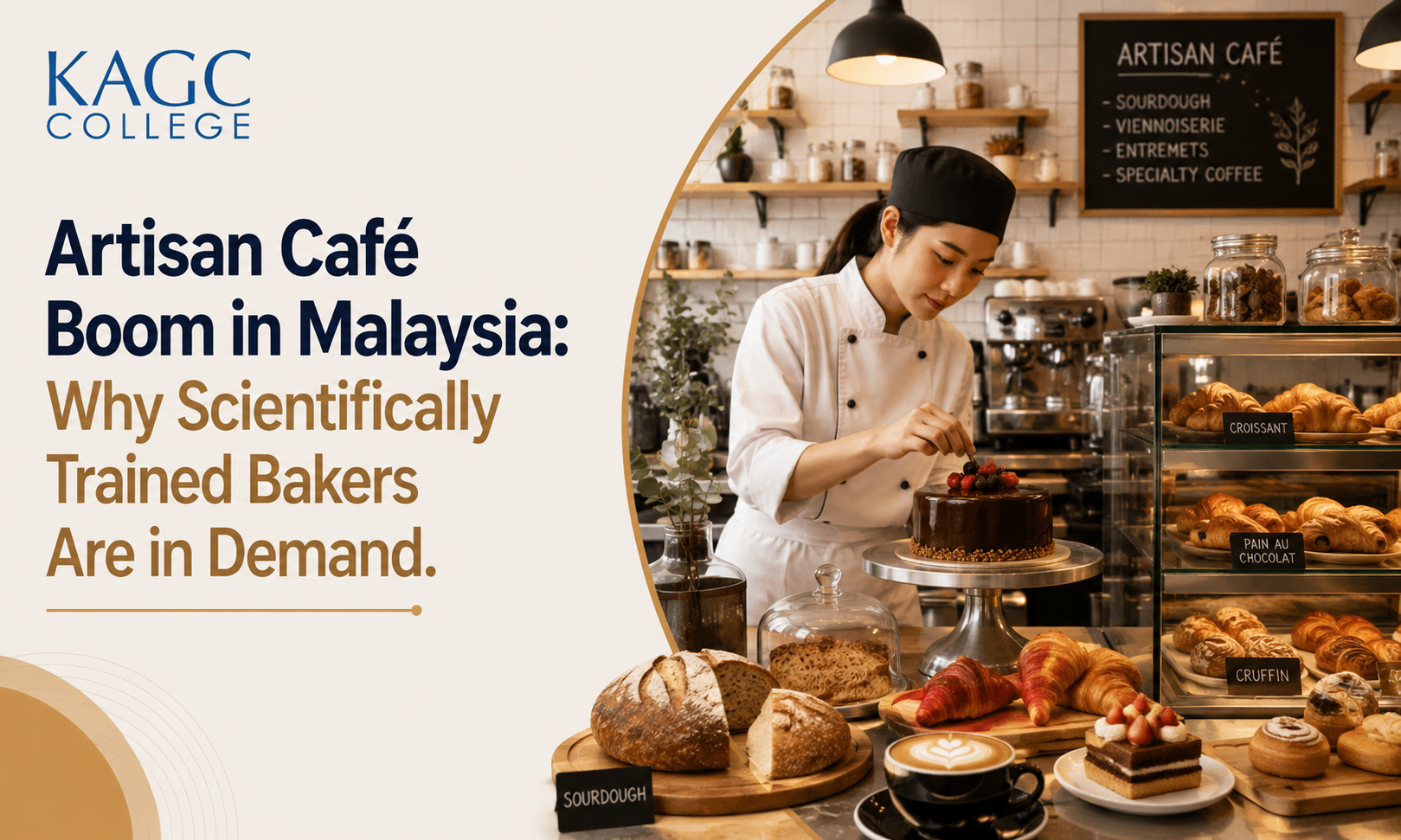


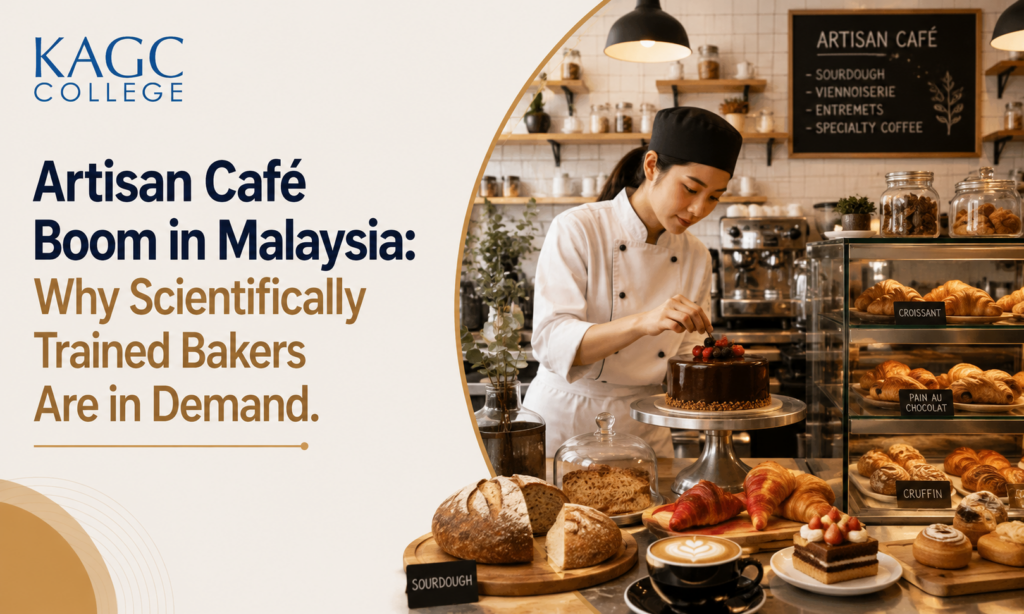
The Artisan Cafe Boom in Malaysia: Why Scientifically Trained Bakers Are in High Demand
Malaysia’s Café Industry Is Growing Faster Than Ever
Walk through any major city in Malaysia today and one trend becomes immediately obvious.
Cafés are everywhere.
From artisan coffee houses and boutique dessert cafés to specialty bakeries and modern brunch concepts, Malaysians are increasingly willing to spend on premium food experiences rather than simply purchasing food for convenience.
This shift has transformed cafés from simple coffee outlets into lifestyle destinations where customers seek quality products, aesthetic presentation, unique flavours, and memorable experiences.
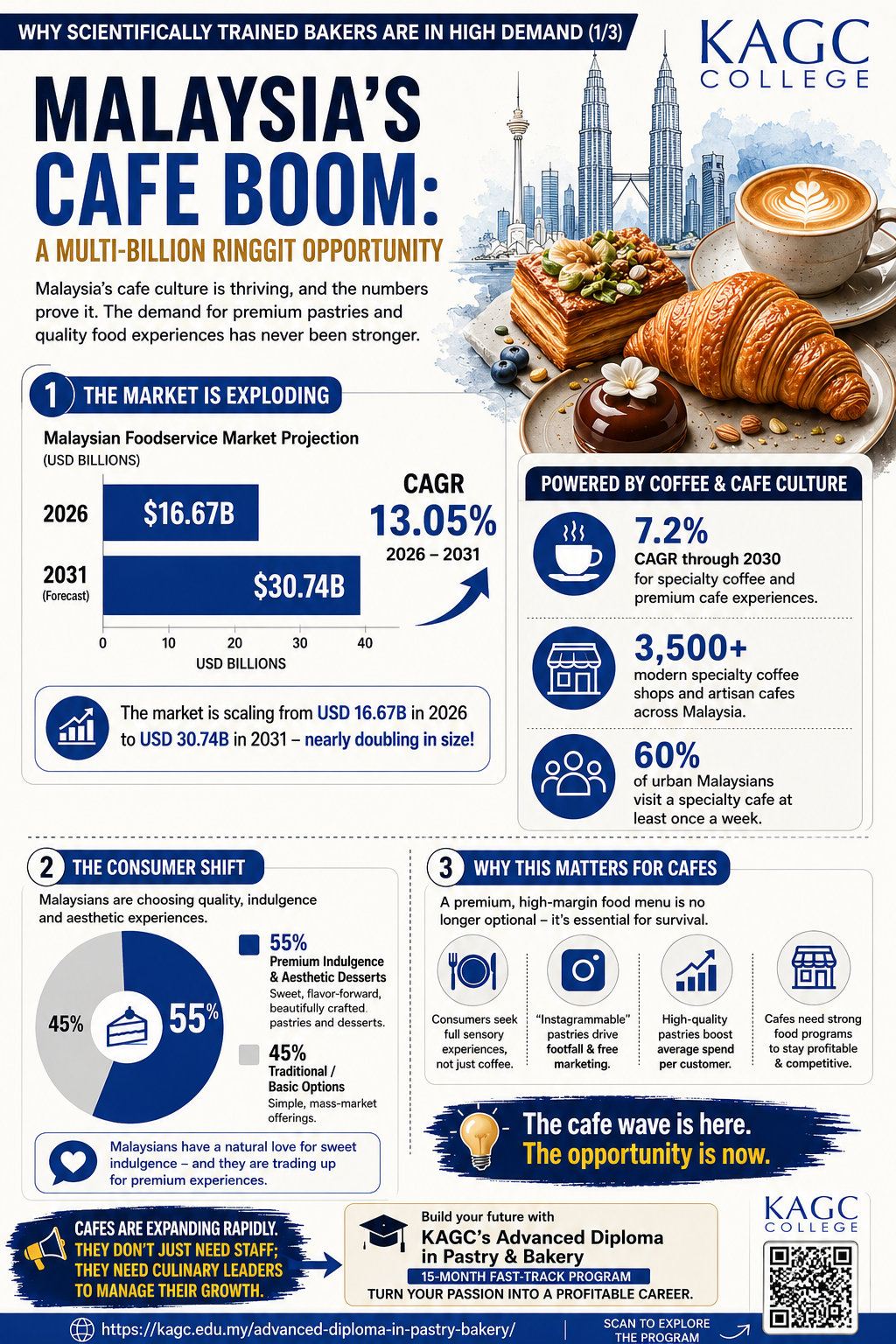
Industry projections suggest Malaysia’s foodservice market is expected to grow significantly over the coming years, driven by rising disposable incomes, urbanisation, tourism growth, and changing consumer preferences. At the same time, specialty cafés and artisan bakeries continue to expand across major cities such as Kuala Lumpur, Penang, Johor Bahru, Kuching, and Kota Kinabalu.
For aspiring pastry professionals, this growth creates a significant opportunity.
However, it also creates a challenge.
As cafés become more sophisticated, employers need bakers who can deliver more than good-looking pastries.
They need professionals who understand both the science and business of baking.
Why Today’s Café Customers Expect More Than Ever Before
The modern café customer is very different from the customer of ten years ago.
Today, consumers evaluate cafés based on multiple factors:
- Product quality
- Visual presentation
- Consistency
- Social media appeal
- Ingredient quality
- Unique menu offerings
- Overall customer experience
A croissant is no longer just a croissant.
Customers compare:
- Flakiness
- Butter quality
- Texture
- Aroma
- Visual appearance
- Authenticity
Likewise, cakes and desserts are judged not only by taste but also by presentation, creativity, and uniqueness.
This growing expectation means café owners must continuously raise their standards.
To meet these expectations, they require skilled pastry professionals who understand how to produce high-quality products consistently and efficiently.
Why Passion Alone Is No Longer Enough
Many successful pastry careers begin with a passion for baking.
However, passion alone does not guarantee professional success.
A home baker may create excellent products through experimentation and practice, but commercial environments demand a different level of expertise.
In a café setting, bakers must be able to:
- Produce consistent results daily
- Work under time pressure
- Minimise ingredient wastage
- Follow production schedules
- Maintain food safety standards
- Scale recipes accurately
- Control costs and profitability
This is where professionally trained bakers gain a significant advantage.
They understand not only what works, but why it works.
That deeper understanding allows them to solve problems, improve efficiency, and maintain quality standards even under challenging production conditions.
What Does It Mean to Be a Scientifically Trained Baker?
Many people are surprised to learn that baking is as much science as it is art.
Every loaf of bread, croissant, cake, and pastry relies on scientific principles.
Professional bakers study concepts such as:
Fermentation
Understanding how yeast behaves under different temperatures, hydration levels, and proofing times.
Gluten Development
Learning how flour proteins interact to create structure, texture, and elasticity.
Lamination
Mastering the process of creating multiple layers in products such as croissants and Danish pastries.
Hydration Control
Managing water content to influence texture, flavour, and product stability.
Temperature Management
Understanding how temperature affects fermentation, baking performance, and product quality.
Ingredient Functionality
Learning how fats, sugars, eggs, dairy products, and other ingredients influence the final outcome.
A scientifically trained baker can troubleshoot problems systematically instead of relying on guesswork.
This capability is extremely valuable in commercial operations where consistency directly impacts customer satisfaction and profitability.
Why Café Owners Prefer Professionally Trained Bakers
For café owners, every product served represents their brand.
An inconsistent product can result in:
- Customer complaints
- Negative reviews
- Food wastage
- Increased costs
- Lost revenue
This is why employers increasingly prefer professionally trained pastry graduates.
The difference is clear:
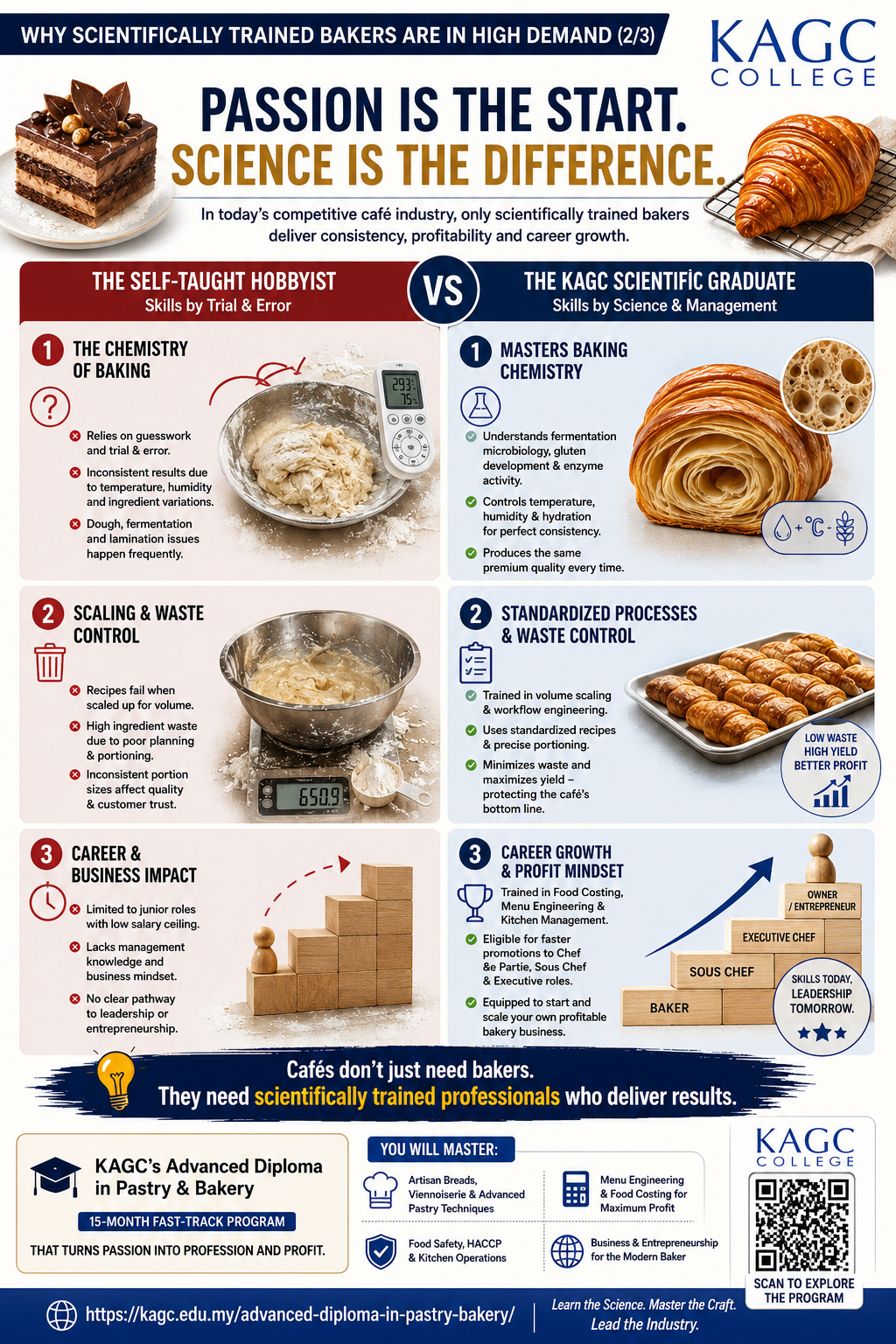
| Self-Taught Baker | Scientifically Trained Baker |
| Relies heavily on trial and error | Uses proven scientific principles |
| Inconsistent results | Consistent quality |
| Limited understanding of scaling | Commercial production knowledge |
| Focuses mainly on recipes | Understands systems and processes |
| Limited business knowledge | Strong cost-control awareness |
| Individual work approach | Team-oriented operations mindset |
A professionally trained baker contributes not only to product quality but also to operational efficiency and profitability.
For business owners, this makes them a valuable investment.
The Hidden Skills Modern Cafés Need
Many people assume café bakers spend their entire day baking.
In reality, successful pastry professionals perform a much broader role.
Modern cafés increasingly seek individuals who understand:
Food Costing
Calculating the true cost of each product before determining selling prices.
Waste Reduction
Reducing losses caused by overproduction, spoilage, and inefficient processes.
Menu Engineering
Designing menus that balance customer demand with profitability.
Inventory Management
Managing ingredient purchasing, stock levels, and supplier relationships.
Quality Control
Ensuring consistency across every batch produced.
Production Planning
Organising workflow to maximise productivity while minimising waste.
These commercial skills are often what separate average cafés from highly profitable ones.
The Café Boom Is Creating New Career Opportunities
The expansion of Malaysia’s café industry is creating opportunities far beyond traditional bakery roles.
Professionally trained pastry graduates can pursue careers such as:
Artisan Baker
Specialising in breads, viennoiserie, and handcrafted baked goods.
Pastry Chef
Producing premium desserts, cakes, pastries, and plated desserts.
Bakery Supervisor
Managing production teams and ensuring operational efficiency.
Product Development Executive
Creating new menu items for cafés, bakeries, and food brands.
Café Operations Manager
Overseeing café operations, customer experience, and profitability.
Food Entrepreneur
Launching independent bakery, café, or dessert businesses.
As the industry continues to evolve, employers increasingly seek professionals who combine technical expertise with business understanding.
The Rise of the Digital Micro-Bakery
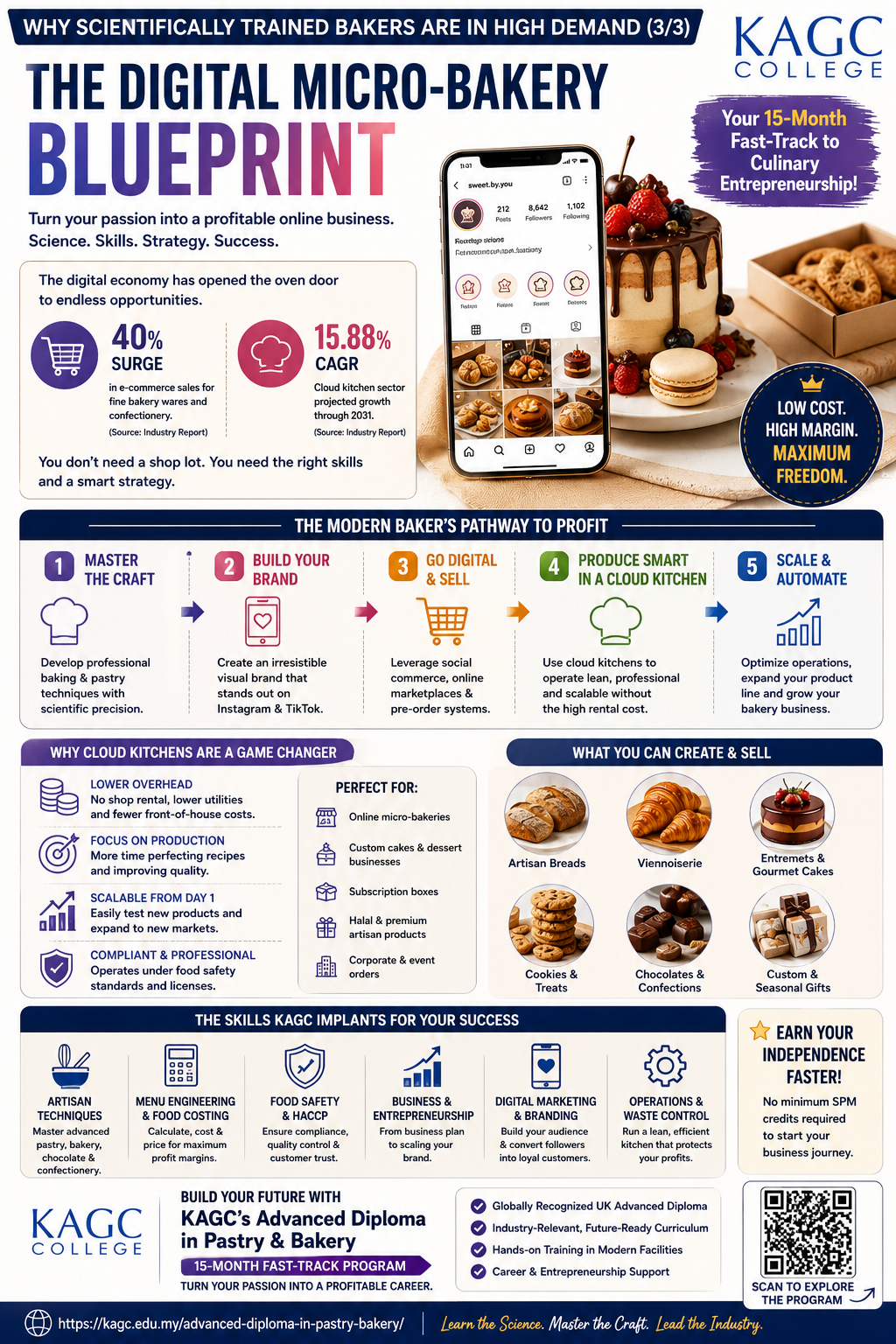
One of the most exciting developments in the pastry industry is the emergence of the digital micro-bakery.
Unlike traditional bakeries, digital micro-bakeries operate through:
- TikTok
- Online ordering platforms
- Messaging applications
- Cloud kitchen models
These businesses often focus on premium products such as:
- Artisan breads
- Croissants
- Entremets
- Celebration cakes
- Seasonal desserts
- Corporate gifting products
The advantages include:
- Lower startup costs
- Reduced rental expenses
- Greater flexibility
- Direct customer relationships
- Strong profit potential
For pastry professionals with entrepreneurial ambitions, this model offers a pathway into business ownership without requiring large capital investments.
However, success still depends on having strong technical skills, food safety knowledge, production efficiency, and business understanding.
Why Professional Education Matters More Than Ever
As the café industry becomes more competitive, employers are becoming increasingly selective.
They are looking for candidates who can contribute immediately and help businesses maintain quality standards while remaining profitable.
Professional education helps accelerate this process by providing structured exposure to:
- Artisan bread production
- Viennoiserie
- Cakes and desserts
- Baking science
- HACCP food safety practices
- Food costing
- Menu engineering
- Bakery entrepreneurship
- Commercial kitchen operations
Rather than spending years learning through trial and error, aspiring pastry professionals can develop these competencies through guided training and industry exposure.
How KAGC Prepares Students for the Modern Café Industry
KAGC College’s Advanced Diploma in Pastry & Bakery is designed around the realities of today’s bakery and café industry.
Students learn both technical and commercial competencies required by employers.
Key areas of training include:
- Artisan bread production
- Viennoiserie techniques
- Modern pastry production
- Baking science
- Food safety and HACCP
- Cost control and pricing strategies
- Menu engineering
- Inventory management
- Entrepreneurship and bakery operations
Combined with extensive practical training and industry exposure, graduates are prepared for careers in bakeries, cafés, hotels, resorts, cruise ships, and entrepreneurial ventures.
The Future Belongs to Skilled Professionals
Malaysia’s café boom shows no signs of slowing down.
As consumer expectations continue to rise, the demand for highly skilled pastry professionals will continue to grow alongside the industry.
The cafés that succeed in the future will not simply be those with attractive interiors or trendy marketing.
They will be the businesses that consistently deliver exceptional products, operational excellence, and memorable customer experiences.
Behind every successful café is a team of professionals who understand both the art and science of baking.
For aspiring pastry professionals, this creates an exciting opportunity to build a rewarding career in one of Malaysia’s fastest-growing foodservice segments.
Frequently Asked Questions
Is the café industry growing in Malaysia?
Yes. Malaysia’s café and foodservice industry continues to expand due to urbanisation, tourism growth, changing consumer preferences, and increasing demand for premium food experiences.
Why are professionally trained bakers in demand?
Employers require professionals who can consistently produce high-quality products while managing food safety, production efficiency, and profitability.
What is baking science?
Baking science involves understanding the principles behind fermentation, gluten development, hydration, temperature control, ingredient functionality, and production consistency.
Can pastry graduates start their own café or bakery?
Yes. Many graduates pursue entrepreneurship by launching cafés, bakeries, dessert businesses, or digital micro-bakeries.
Is pastry and bakery a good career in Malaysia?
The growing café, hospitality, tourism, and foodservice sectors continue to create opportunities for skilled pastry and bakery professionals throughout Malaysia and internationally.
The landscape of Malaysian foodservice is undergoing a dramatic and lucrative transformation, driven by an urban population with a sophisticated palate and a deep appreciation for experiential dining. This page features a comprehensive infographic that visualizes the incredible growth of the artisan cafe sector across the country. This boom is heavily supported by market data projecting the foodservice industry to scale from USD 16.67 billion in 2026 to USD 30.74 billion by 2031. Consumer behavior is also shifting, with specialty cafe visits charting a 7.2% growth and 55% of urban consumers prioritizing premium indulgence and aesthetic appeal.
However, this rapid expansion creates a unique challenge for cafe operators: finding chefs who can produce high-end, complex pastries with absolute consistency while maintaining profitable business operations. Traditional on-the-job training is no longer sufficient. The industry is now desperately seeking professionals who are “scientifically trained”—individuals who understand the precise chemistry of fermentation and lamination, the technical logistics of high-volume standardized scaling, and the business acumen required for strict food costing and menu engineering. A casual hobbyist is a liability; a scientifically trained baker is the key to consistency and profitability in a market with a high 40% risk of closure for new independent operators.
Learn how KAGC’s Advanced Diploma in Pastry & Bakery bridges this exact skills gap, turning passionate students into highly valued culinary leaders and successful micro-bakery entrepreneurs who can meet the sophisticated demands of today’s booming market.
Explore More Pastry & Bakery Resources
Interested in learning more about the profession?