

AI Is Transforming Marketing—But Not in the Way Most People Think
Few technologies have created as much excitement and concern as Artificial Intelligence (AI).
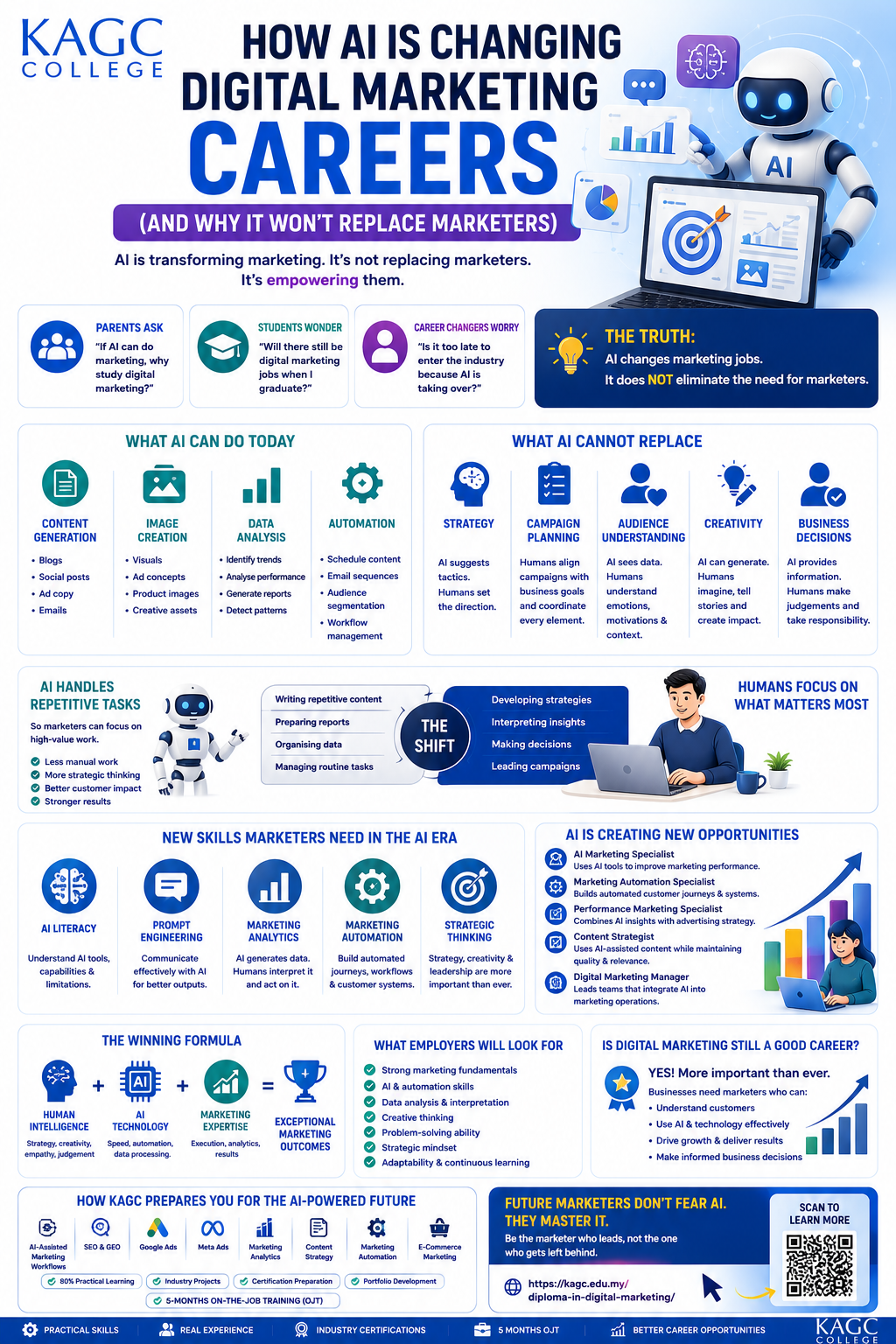
Parents often ask:
“If AI can write content, generate images, analyse data, and even build marketing campaigns, why should someone study digital marketing?”
Students wonder:
“Will there still be digital marketing jobs when I graduate?”
Career changers worry:
“Is it too late to enter the industry because AI is taking over?”
These concerns are understandable.
AI is changing the way marketing works.
However, there is an important distinction that many people overlook:
AI is changing marketing jobs. It is not eliminating the need for marketers.
In fact, AI is creating new opportunities for professionals who understand how to combine technology, strategy, creativity, and business thinking.
The future belongs not to people who compete against AI, but to those who know how to work alongside it.
What AI Can Already Do Today
Modern AI tools can perform tasks that previously required significant time and effort.
Examples include:
Content Generation
AI can:
- Draft blog articles
- Generate social media captions
- Create advertising copy
- Produce email campaigns
Image Creation
AI can:
- Generate marketing visuals
- Create advertising concepts
- Produce product images
- Design creative assets
Data Analysis
AI can:
- Identify trends
- Analyse campaign performance
- Generate reports
- Detect customer patterns
Automation
AI can:
- Schedule content
- Trigger email sequences
- Segment audiences
- Manage repetitive workflows
There is no doubt that AI is increasing efficiency across the marketing industry.
What AI Cannot Replace
Despite its capabilities, AI still has significant limitations.
AI can generate outputs.
Humans provide direction.
AI can process data.
Humans provide judgment.
AI can automate tasks.
Humans make decisions.
The most valuable aspects of marketing remain deeply human.
1. Strategy Still Requires Human Thinking
AI can suggest marketing tactics.
But it cannot truly understand business objectives in the way experienced marketers can.
For example:
A company wants to:
- Enter a new market
- Launch a new product
- Reposition its brand
- Increase market share
These decisions require:
- Strategic thinking
- Market understanding
- Business judgement
- Competitive analysis
Humans determine the destination.
AI helps optimise the journey.
2. Campaign Planning Requires Human Leadership
Successful marketing campaigns involve many moving parts.
Marketers must decide:
- Target audiences
- Marketing channels
- Campaign objectives
- Budget allocation
- Success metrics
AI can assist with recommendations.
However, humans must coordinate and align all campaign activities with business goals.
Campaign leadership remains a human responsibility.
3. Audience Understanding Requires Human Empathy
Marketing is ultimately about people.
Customers make purchasing decisions based on:
- Emotions
- Motivations
- Trust
- Experiences
- Aspirations
AI can analyse behavioural patterns.
But understanding human emotions, cultural context, and consumer psychology remains a uniquely human strength.
The best marketers understand both data and people.
4. Creativity Remains a Human Advantage
AI can generate content.
But originality, storytelling, and creative concepts still require human imagination.
Consider some of the world’s most memorable marketing campaigns.
Their success often comes from:
- Unique insights
- Emotional storytelling
- Cultural relevance
- Creative risk-taking
AI can help execute creative ideas.
Humans create the ideas worth executing.
5. Business Decisions Cannot Be Automated Entirely
Marketing decisions affect:
- Revenue
- Brand reputation
- Customer relationships
- Business growth
Because of this, organisations still need professionals who can evaluate risks and make informed decisions.
AI provides information.
Humans remain accountable for outcomes.
How AI Is Actually Changing Marketing Careers
Rather than replacing marketers, AI is changing what marketers spend their time doing.
Before AI
Marketers often spent hours:
- Writing repetitive content
- Preparing reports
- Organising data
- Managing routine tasks
After AI
Marketers spend more time:
- Developing strategies
- Interpreting insights
- Making decisions
- Improving customer experiences
- Leading campaigns
In many cases, AI removes low-value repetitive work and allows marketers to focus on higher-value activities.
The New Skills Digital Marketers Need
As AI becomes part of everyday marketing workflows, employers are seeking professionals with a new combination of skills.
AI Literacy
Marketers should understand:
- How AI tools work
- AI capabilities and limitations
- Responsible AI usage
Prompt Engineering
Knowing how to communicate effectively with AI tools is becoming an increasingly valuable skill.
Strong prompts lead to better outputs.
Marketing Analytics
AI generates data.
Humans must interpret it.
Understanding analytics remains essential.
Marketing Automation
Businesses increasingly automate:
- Email campaigns
- Lead nurturing
- Customer journeys
- CRM workflows
Marketers must know how to build and manage these systems.
Strategic Thinking
As AI handles more execution, strategy becomes even more valuable.
Which Digital Marketing Jobs Are Growing Because of AI?
AI is creating demand for new types of marketing roles.
Examples include:
AI Marketing Specialist
Uses AI tools to improve marketing performance.
Marketing Automation Specialist
Builds automated customer journeys and workflows.
Performance Marketing Specialist
Combines AI insights with advertising strategy.
Content Strategist
Uses AI-assisted content production while maintaining quality and relevance.
Digital Marketing Manager
Leads teams that integrate AI into marketing operations.
Rather than reducing opportunities, AI is expanding the range of specialised marketing careers.
Is Digital Marketing Still a Good Career with AI?
Absolutely.
In fact, many industry experts believe digital marketing is becoming even more important.
Businesses now need professionals who can:
- Understand customers
- Manage technology
- Interpret AI insights
- Create growth strategies
- Make business decisions
As AI adoption increases, organisations need skilled people who know how to use these tools effectively.
The competitive advantage no longer comes from avoiding AI.
It comes from mastering it.
What Employers Will Look For in the Future
The most employable digital marketers will not be those who ignore AI.
They will be those who combine:
Technical Skills
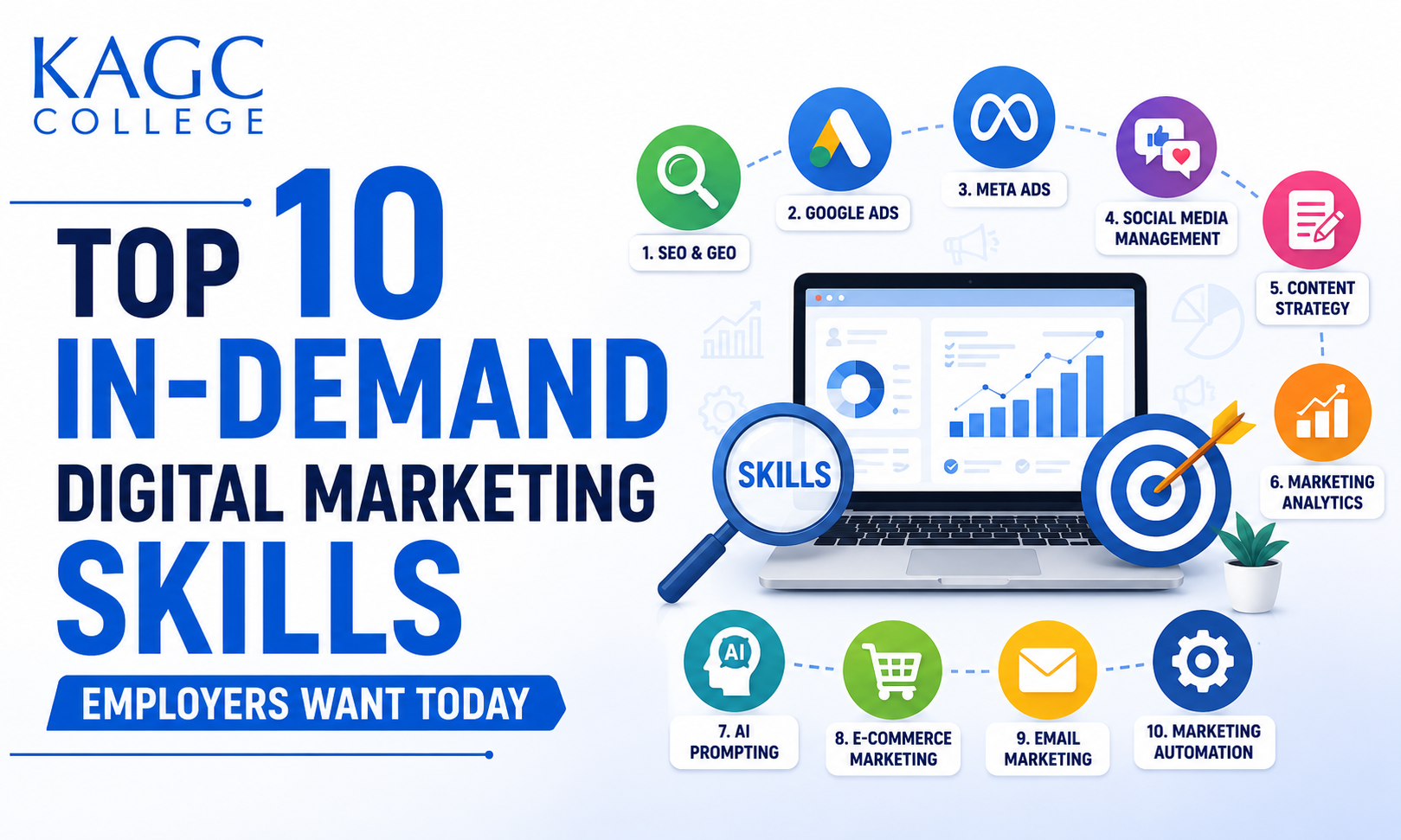
- SEO & GEO
- Google Ads
- Meta Ads
- Analytics
AI Skills
- Prompt engineering
- AI content creation
- AI-assisted research
- Automation tools
Human Skills
- Creativity
- Communication
- Leadership
- Problem-solving
- Strategic thinking
The future marketer will be both technologically capable and strategically minded.
Why Learning Digital Marketing Is More Important Than Ever
Some people assume AI makes learning digital marketing unnecessary.
The opposite is true.
To use AI effectively, marketers must first understand:
- Marketing fundamentals
- Consumer behaviour
- Campaign strategy
- Advertising principles
- Content development
- Data interpretation
Without marketing knowledge, AI-generated outputs become less effective.
AI is a tool.
Marketing expertise remains the foundation.
How KAGC Prepares Students for the AI-Powered Marketing Industry
KAGC College’s Extended Diploma in Digital Marketing is designed to prepare learners for the realities of modern marketing.
Students gain exposure to:
- SEO & GEO
- Google Ads
- Meta Advertising
- Marketing Analytics
- Content Marketing
- E-Commerce Marketing
- AI-Assisted Marketing Workflows
The programme also focuses on:
- 80% practical learning
- Industry projects
- Portfolio development
- Marketing automation concepts
- AI productivity tools
- Workplace exposure through OJT
Students learn not only how marketing works today but also how the industry is evolving for tomorrow.
Conclusion: AI Will Not Replace Marketers—But Marketers Who Use AI Will Replace Those Who Don’t
The future of marketing is not humans versus AI.
It is humans working with AI.
Artificial Intelligence is removing repetitive tasks, increasing efficiency, and creating new opportunities across the marketing industry.
However, strategy, creativity, leadership, audience understanding, and business decision-making remain uniquely human strengths.
The marketers who thrive in the future will be those who combine:
- Marketing expertise
- Digital skills
- AI knowledge
- Strategic thinking
For students, parents, and career changers evaluating the future of digital marketing, the message is clear:
AI is not a reason to avoid digital marketing. It is a reason to learn it properly.
Frequently Asked Questions (FAQ)
Will AI replace digital marketers?
No. AI can automate repetitive tasks, but businesses still need marketers to create strategies, understand customers, and make business decisions.
Is digital marketing still a good career with AI?
Yes. AI is creating new opportunities and increasing demand for marketers who understand both technology and business.
What marketing jobs are most affected by AI?
Routine and repetitive tasks are becoming more automated. Strategic, analytical, and creative roles continue to grow in importance.
What AI skills should digital marketers learn?
Prompt engineering, AI content creation, marketing automation, AI-assisted research, and data analysis are becoming increasingly valuable.
Can AI run marketing campaigns without humans?
AI can assist with execution and optimisation, but humans are still required to set objectives, approve strategies, manage budgets, and evaluate business outcomes.
Should students still study digital marketing if AI exists?
Yes. Understanding marketing fundamentals, consumer behaviour, strategy, and analytics is more important than ever because these skills enable marketers to use AI effectively.
Explore More Digital Marketing Resources
Interested in learning more about the profession?