

How Digital Marketing Drives Hotel Bookings
Every time a traveler books a weekend stay at a resort in Langkawi or a boutique hotel in Kuala Lumpur, an invisible, multi-million-dollar war plays out behind the screens.
On one side are Online Travel Agencies (OTAs) like Agoda, Booking.com, and Expedia. On the other side are the hotels themselves.
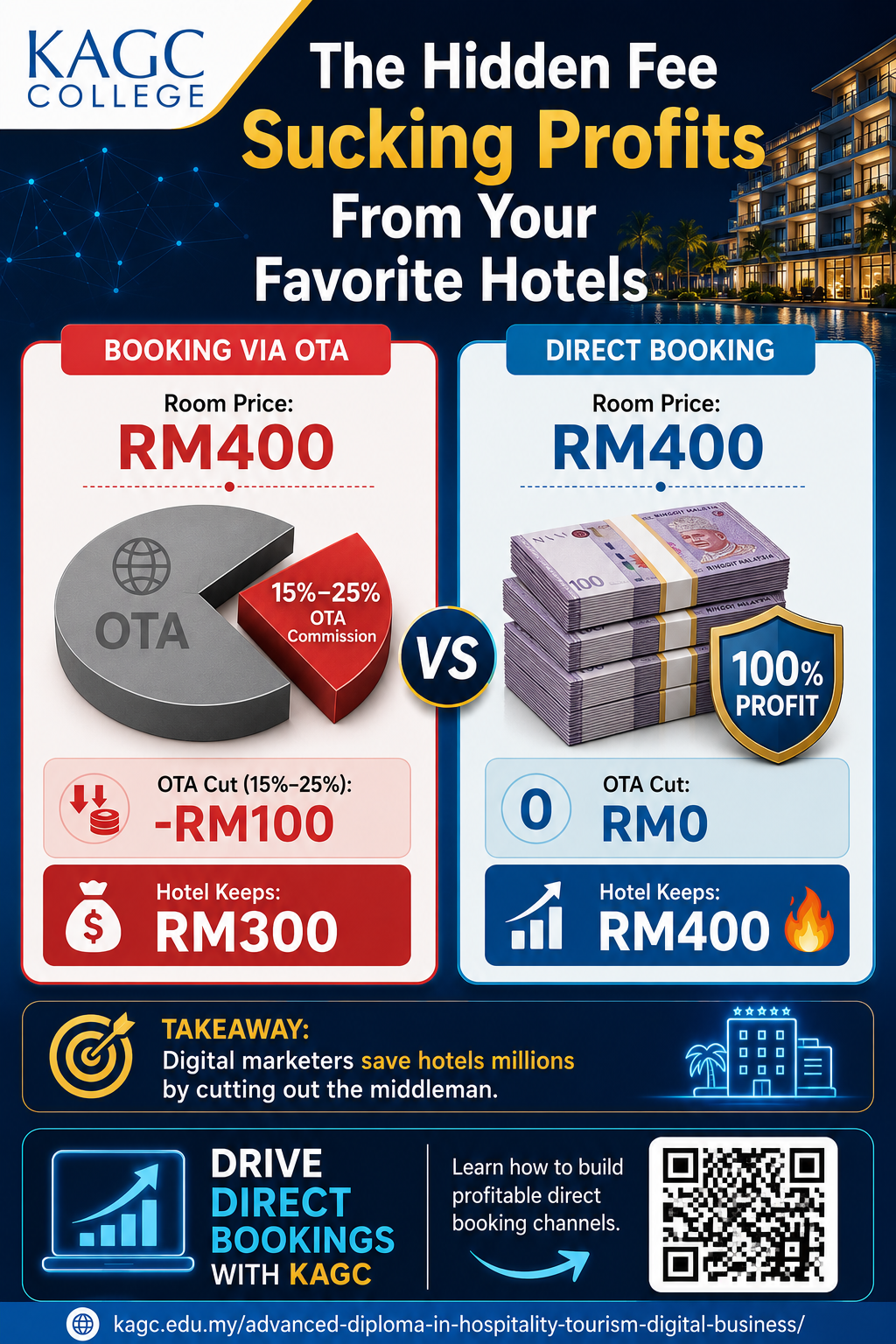
While OTAs provide incredible visibility, they charge hotels massive commission fees—often between 15% to 25% of the total room price. If a guest books a RM400 room through an OTA, the hotel might only pocket RM300. For a 200-room hotel, these fees drain hundreds of thousands of ringgit in profit every year.
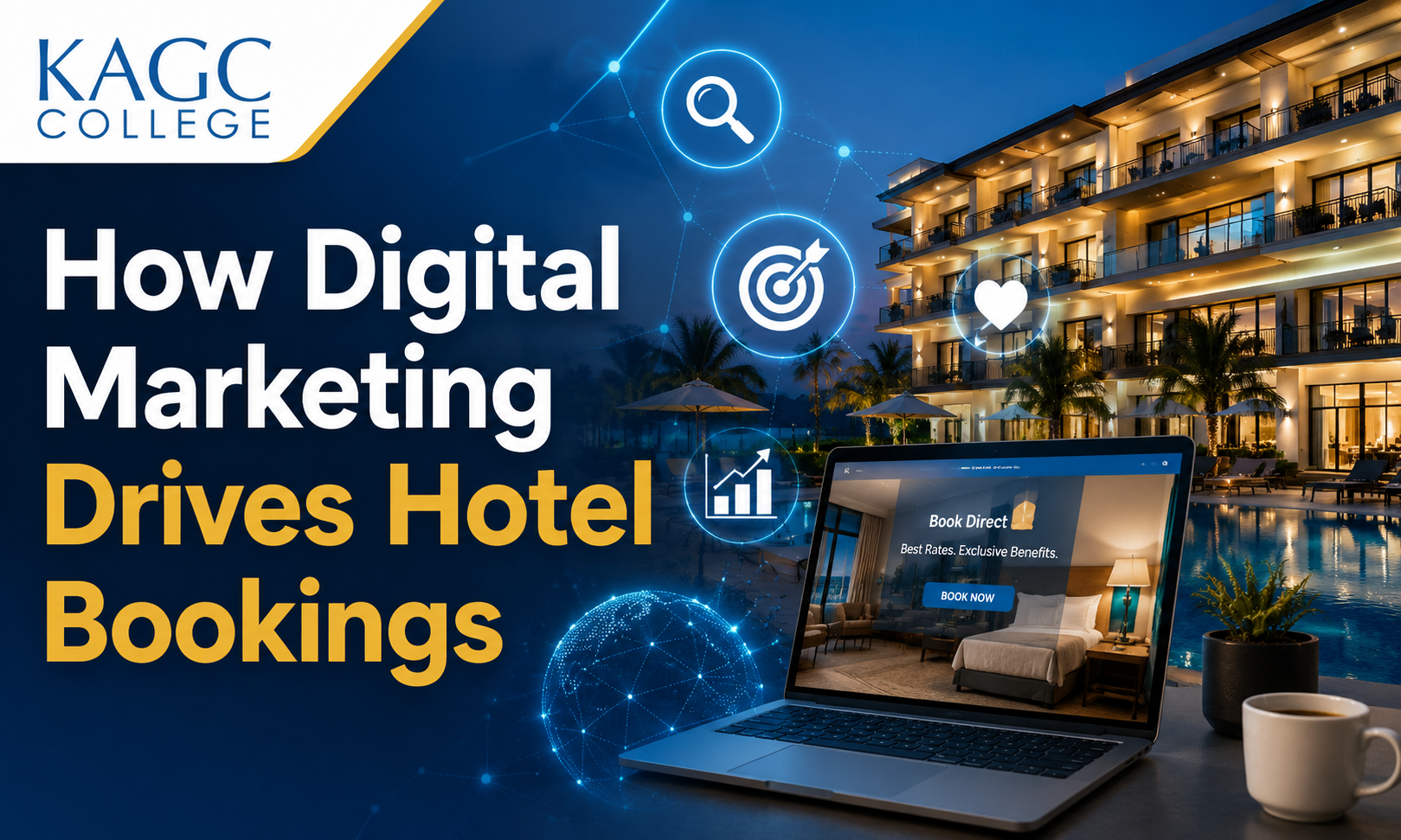
This is why hospitality digital marketing has become the most critical survival skill in the modern industry. Successful hotels no longer just wait for guests to find them on third-party sites; they use digital strategies to win direct bookings through their own websites, keeping 100% of their revenue.
The Digital Guest Journey: From Scroll to Stay
To understand how digital business drives revenue, you must understand how a modern traveler makes decisions. It rarely happens overnight. Instead, it follows a structured digital funnel.
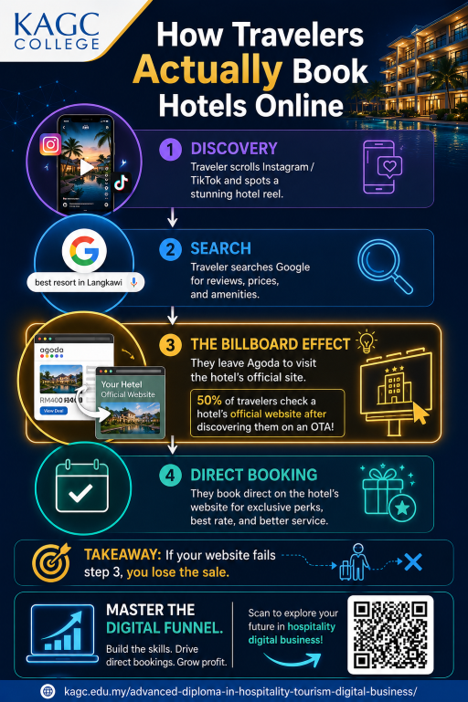
To capture travelers at every stage of this journey, hotels deploy four core digital growth pillars.
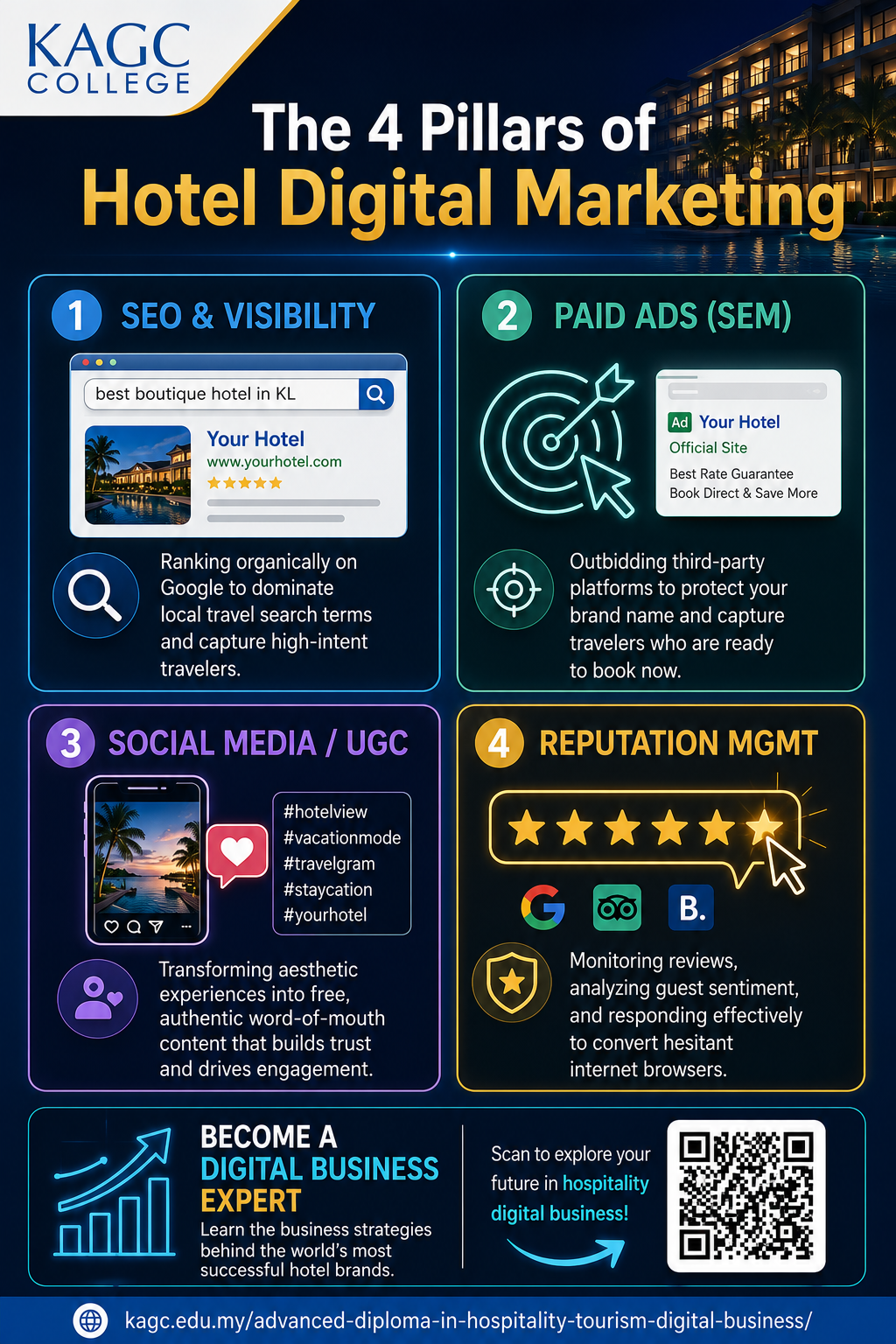
The 4 Pillars of Hotel Digital Marketing
1. Search Engine Optimization (SEO) & The “Billboard Effect”
When someone types “best resort in Port Dickson” or “5-star hotel near KLCC” into Google, the top organic results capture over 50% of all clicks.
Furthermore, even when guests discover a hotel on Agoda, behavior data shows that over 50% of them will visit the hotel’s official website directly to look for better photos or exclusive perks. This is known as the Billboard Effect. If a hotel’s website is slow, poorly designed, or unoptimized for search engines, they lose that direct customer forever.
2. Search Engine Marketing (SEM / Google Ads)
If a hotel doesn’t rank organically for its own name, competitors or OTAs will bid on their branded keywords. For example, if you search for a specific hotel name, the first result you see is often an ad by an OTA claiming to have the “cheapest rate” for that exact hotel.
Modern hospitality executives use hyper-targeted Google Ads campaigns to protect their brand name and capture high-intent travelers who are ready to book a room right now.
3. Social Media & User-Generated Content (UGC)
Hospitality is an inherently visual industry. Travelers do not buy rooms; they buy experiences, aesthetics, and memories.
By utilizing platforms like Instagram, TikTok, and Xiaohongshu (RED), hotels can showcase behind-the-scenes luxury, exquisite dining options, and local travel guides. When influencers or everyday guests tag the hotel in their photos, it creates User-Generated Content (UGC)—the digital equivalent of word-of-mouth advertising that builds immense social proof.
4. Reputation Management (Online Reviews)
A single bad review on TripAdvisor or Google Maps can cost a hotel dozens of bookings. Digital marketing isn’t just about putting out beautiful ads; it is about managing the hotel’s digital reputation. Actively responding to reviews, analyzing guest sentiment data, and implementing online service recovery strategies are vital to maintaining a high conversion rate.
 Direct Bookings vs. OTA Bookings: A Strategic Comparison
| Feature | Direct Booking (Hotel Website) | OTA Booking (Agoda / Booking.com) |
| Profit Margin | High (0% commission fees paid out) | Low (15% – 25% cut taken by third party) |
| Customer Data | Owned by Hotel (Enables long-term loyalty marketing) | Owned by OTA (Hotel gets minimal guest details) |
| Guest Relationship | Begins instantly via direct confirmation emails | Intermediated by a third-party customer service line |
| Value Inclusions | Can offer free breakfast or late check-out perks | Bound by rigid, standard platform terms |
Become the Digital Growth Engine the Industry Needs
The global shift toward digitalization means that traditional hospitality roles are evolving rapidly. Employers looking for management talent in hospitality management Malaysia are no longer just seeking front-of-house operational managers. They are hunting for commercially-minded professionals who understand search engine algorithms, return on ad spend (ROAS), and digital customer acquisition.
If you want to break into this high-demand sector, a traditional, service-only hospitality course isn’t enough. You need to combine operational expertise with a modern digital business course.
The KAGC Advantage: Shifting from Service to Strategy
At KAGC College, our Advanced Diploma in Hospitality & Tourism Digital Business is specifically engineered to bridge this gap. Through a hands-on, project-based curriculum, you won’t just study hospitality and tourism management from old textbooks. You will learn how to:
- Build and execute targeted SEO and social media campaigns tailored for luxury travel brands.
- Analyze digital marketing metrics and utilize Google Analytics to understand traveler behavior.
- Manage booking systems and digital workflows to maximize direct room sales.
- Gain real-world experience through our fast-track 15-month program, which includes 6 months of invaluable Industry On-the-Job Training (OJT).
The future of tourism belongs to those who control the digital channels. Stop just looking at the industry as a guest—learn how to orchestrate the digital strategies that drive global travel markets.
Explore More Hospitality & Tourism Digital Business Resources
Interested in learning more about the profession?