

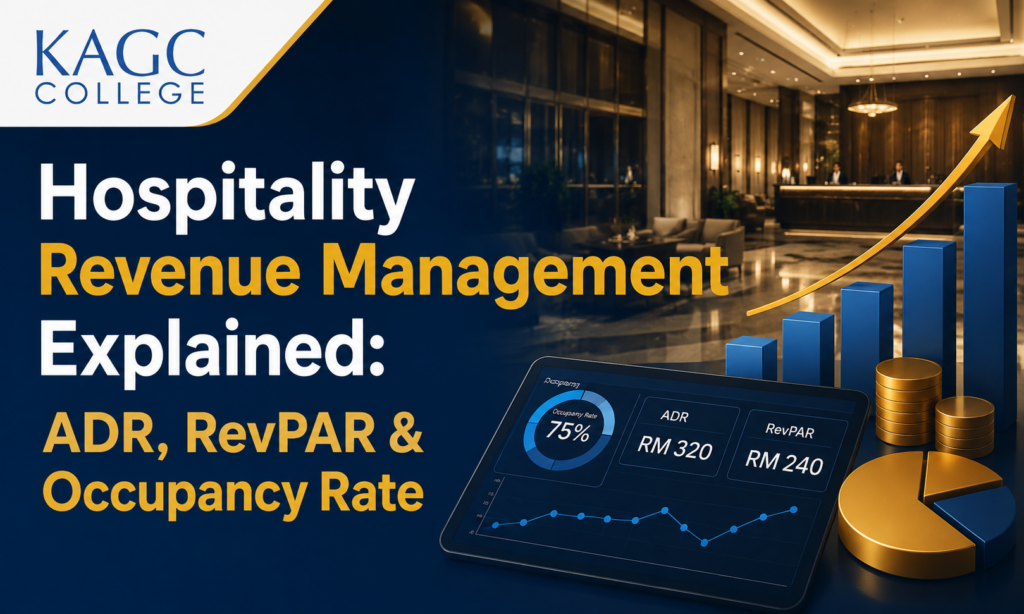
Hospitality Revenue Management Explained: ADR, RevPAR & Occupancy Rate
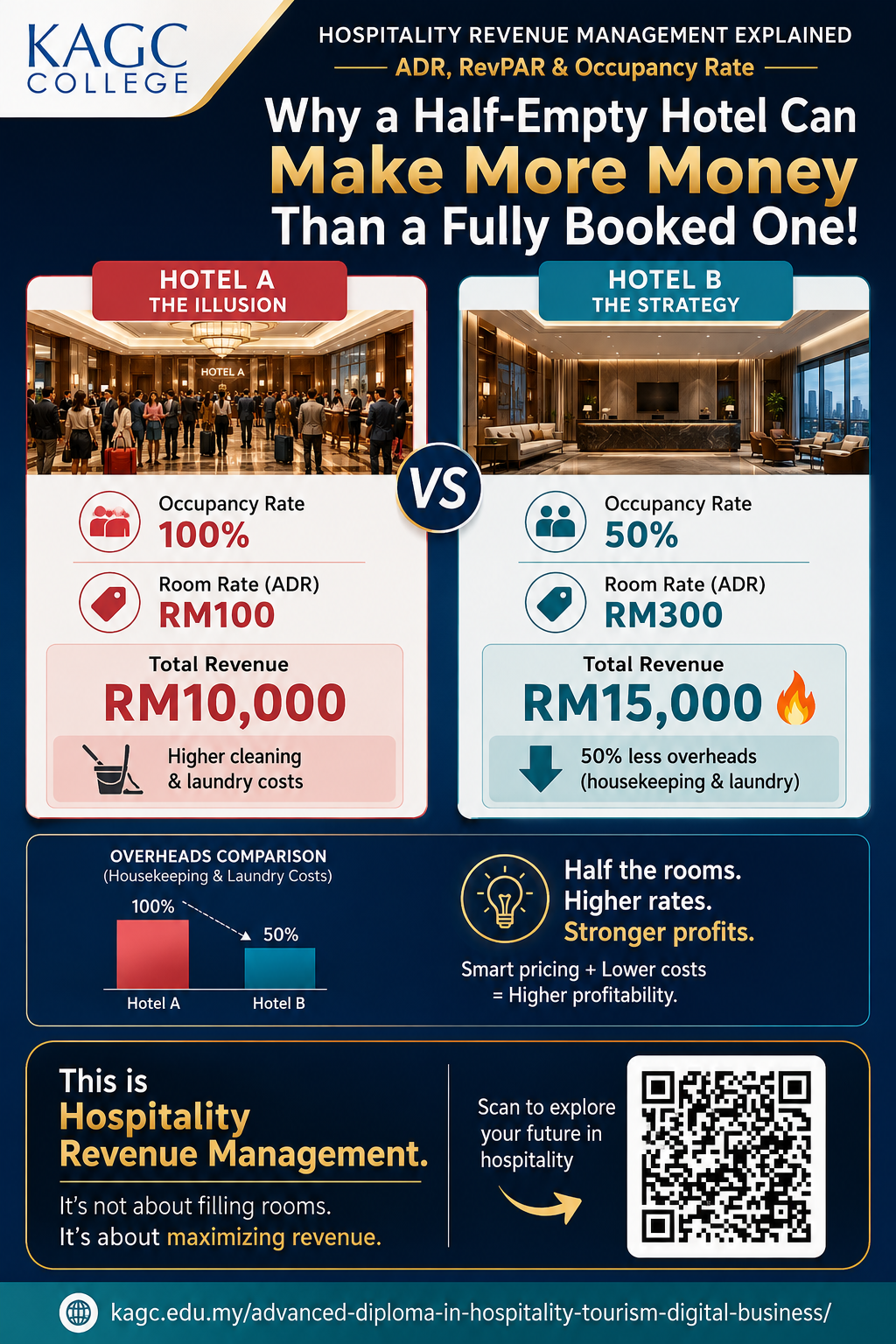
Imagine two hotels sitting directly across the street from each other. Both have 100 rooms. Hotel A is completely booked tonight, boasting a 100% occupancy rate. Hotel B is only half full, sitting at a 50% occupancy rate.
At first glance, you might think Hotel A is winning the night. But what if Hotel A slashed its room rates to just RM100 to fill those rooms, while Hotel B charged a premium price of RM300 per room?
- Hotel A’s Revenue: 100 rooms × RM100 = RM10,000
- Hotel B’s Revenue: 50 rooms × RM300 = RM15,000
Despite having half the guests, Hotel B made RM5,000 more in revenue while incurring half the housekeeping and laundry costs.
This is the power of Hospitality Revenue Management. It is the data-driven science of selling the right room to the right guest at the right time through the right distribution channel to maximize profitability.
If you want to study hospitality and tourism management, understanding this ecosystem is what separates operational staff from high-earning corporate executives. Let’s break down the three fundamental metrics that drive every major hotel’s financial strategy.
The Big Three: Occupancy, ADR, and RevPAR
To manage a hotel’s financial health, revenue managers live and breathe three core Key Performance Indicators (KPIs).
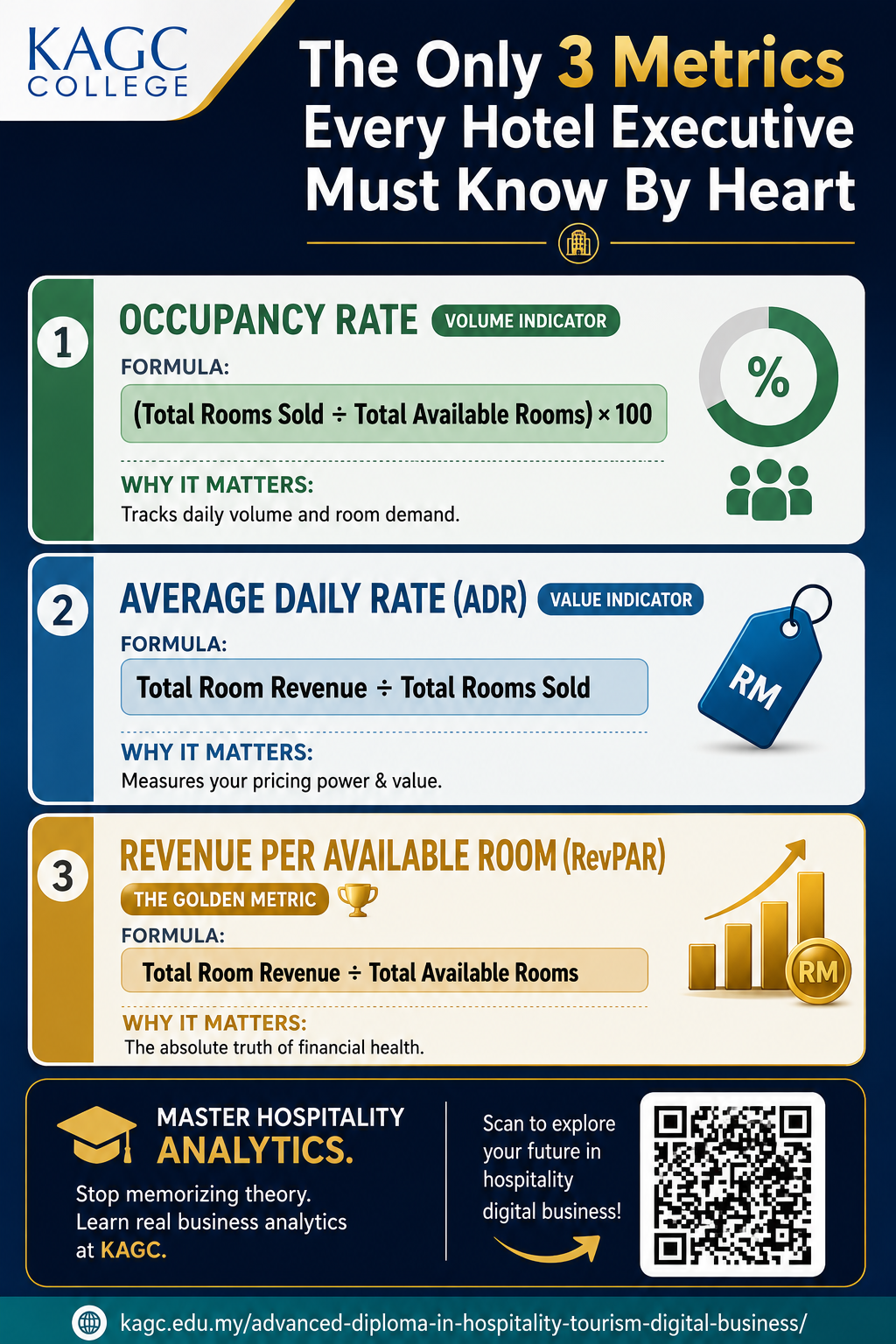
1. Occupancy Rate (The Volume Indicator)
The Occupancy Rate tells you what percentage of your available rooms are filled over a specific period. While a high occupancy rate is great for atmosphere and ancillary spending (like dining or spa services), it shouldn’t come at the cost of bleeding profits through ultra-low room rates.
How it’s calculated:
(Total Rooms Sold / Total Available Rooms) × 100 = Occupancy Rate (%)
2. ADR – Average Daily Rate (The Value Indicator)
ADR measures the average realized income per occupied room per day. It doesn’t take empty rooms into account; it purely looks at the average price paid by the guests who actually checked in.
How it’s calculated:
Total Room Revenue / Total Rooms Sold = ADR
3. RevPAR – Revenue Per Available Room (The Golden Metric)
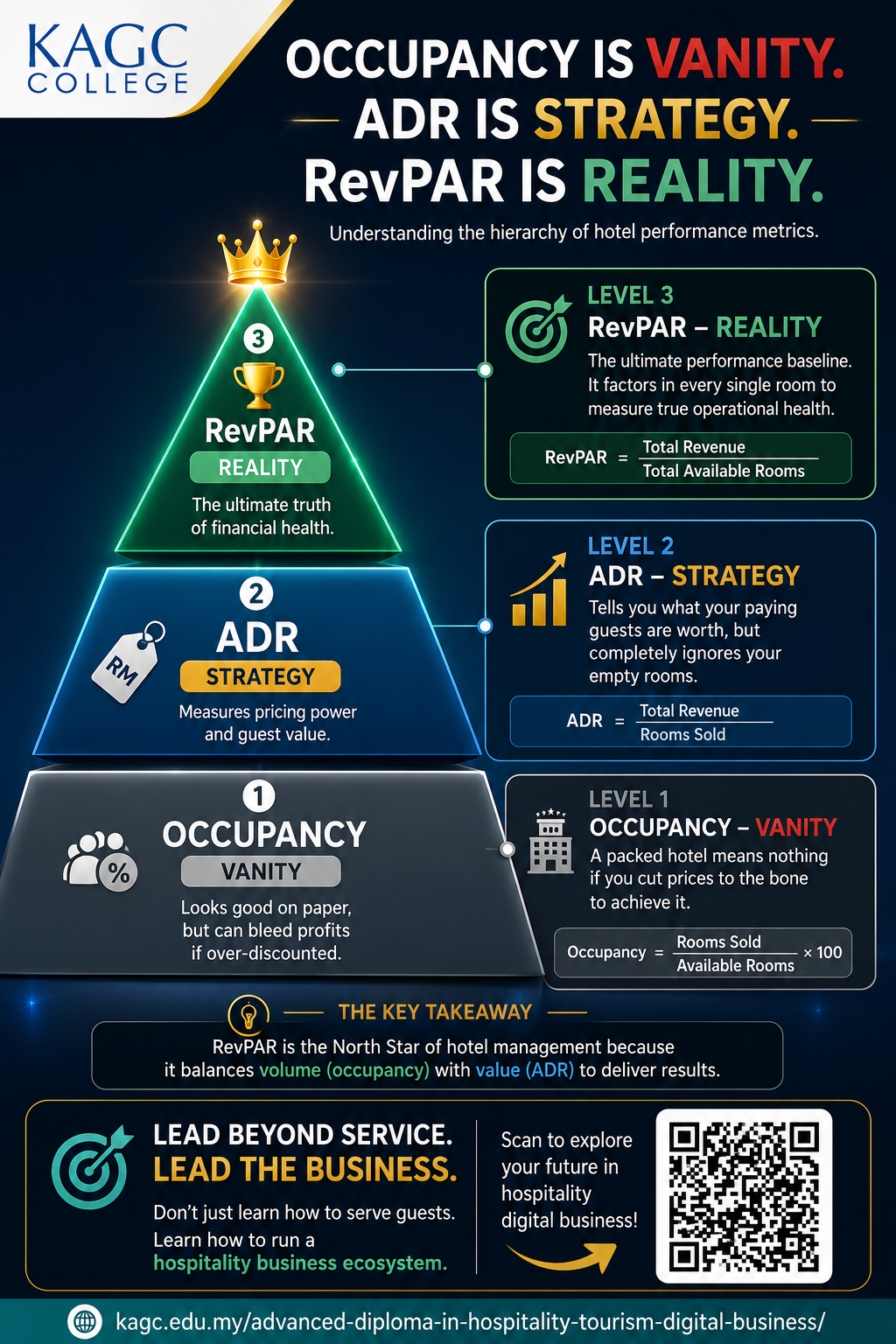
If you talk to any senior manager in hospitality management Malaysia or globally, RevPAR is the metric they care about most. RevPAR combines both occupancy and pricing to give an accurate, real-time snapshot of a hotel’s overall operational health because it calculates revenue against all available rooms, whether they are occupied or empty.
How it’s calculated:
Total Room Revenue / Total Available Rooms = RevPAR
(Alternatively: ADR × Occupancy Rate = RevPAR)
Quick Reference: Comparing the Metrics
| Metric | What It Measures | Why It Matters |
| Occupancy Rate | The percentage of filled rooms. | Tracks volume, demand, and operational utilization. |
| Average Daily Rate (ADR) | The average price paid per occupied room. | Measures pricing power and market positioning. |
| Revenue Per Available Room (RevPAR) | Net financial performance across the entire inventory. | The ultimate baseline for overall hotel profitability. |
The Digital Shift: Revenue Optimization Today
The days of setting a fixed room rate for the entire year are long gone. Today, the sector operates on dynamic pricing—the same algorithmic system used by airlines and ride-sharing apps.
Modern revenue management heavily intersects with hospitality digital marketing. Prices fluctuate based on weather, local concerts, competitor rates, flight arrivals, and online search trends. If a sudden surge of travellers searches online for a weekend getaway in Kuala Lumpur, automated software will adjust room pricing instantly to optimize RevPAR.
To succeed in this modern landscape, hospitality professionals cannot just rely on traditional hospitality training. You need a solid foundation in data analytics, digital tools, and consumer psychology.
Turn Financial Insights into a High-Flying Career with KAGC
If analyzing market demand, mastering digital business platforms, and steering multi-million-dollar assets sounds more exciting than simply working a front desk, you are exactly who the modern industry is looking for.
KAGC College offers a uniquely engineered Advanced Diploma in Hospitality & Tourism Digital Business. Unlike a traditional tourism and management coursethat focuses strictly on service delivery, this innovative digital business course merges core hospitality operations with cutting-edge commercial strategies.
Why Choose KAGC’s Future-Ready Program?
- The Business of Hospitality: Learn how to read dashboards, calculate complex pricing matrices, and build digital business strategies that directly improve organizational performance.
- 15-Month Fast Track: Maximize your timeline with 9 months of high-impact classroom learning paired with 6 months of real-world Industry On-the-Job Training (OJT).
- Global Recognition: Graduate with a UK Advanced Diploma endorsed by the City College of Birmingham, instantly opening doors to international hotel groups and global online travel agencies (OTAs).
The hospitality world has evolved into a digital-first ecosystem. Don’t just learn how to work in a hotel—learn how to run the business.
Explore More Hospitality & Tourism Digital Business Resources
Interested in learning more about the profession?