

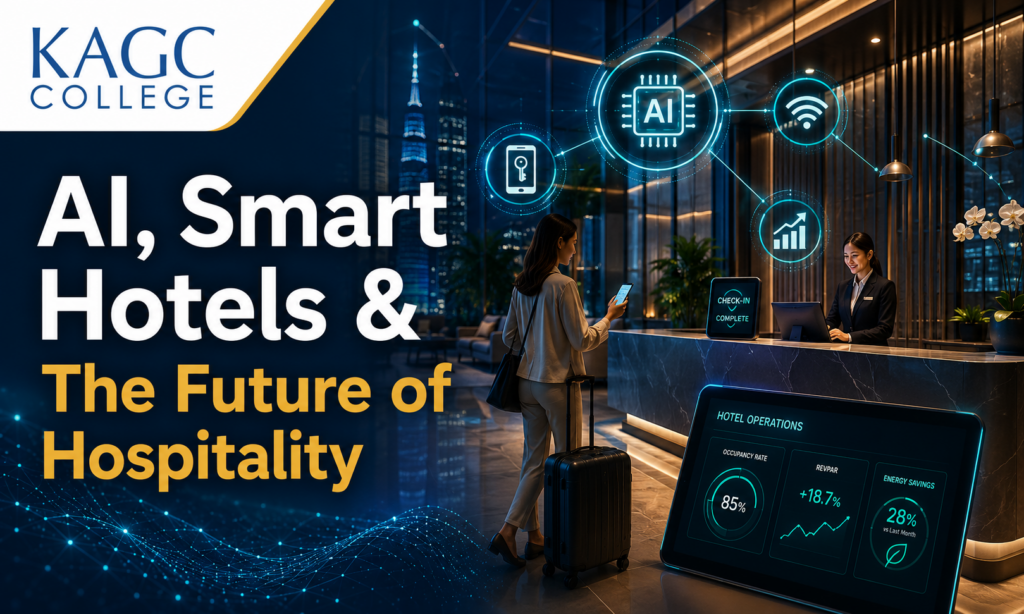
AI, Smart Hotels & The Future of Hospitality
When people think of artificial intelligence (AI) in a hotel, they often picture a clunky, gimmick robot delivering a bottle of water to a guest room.
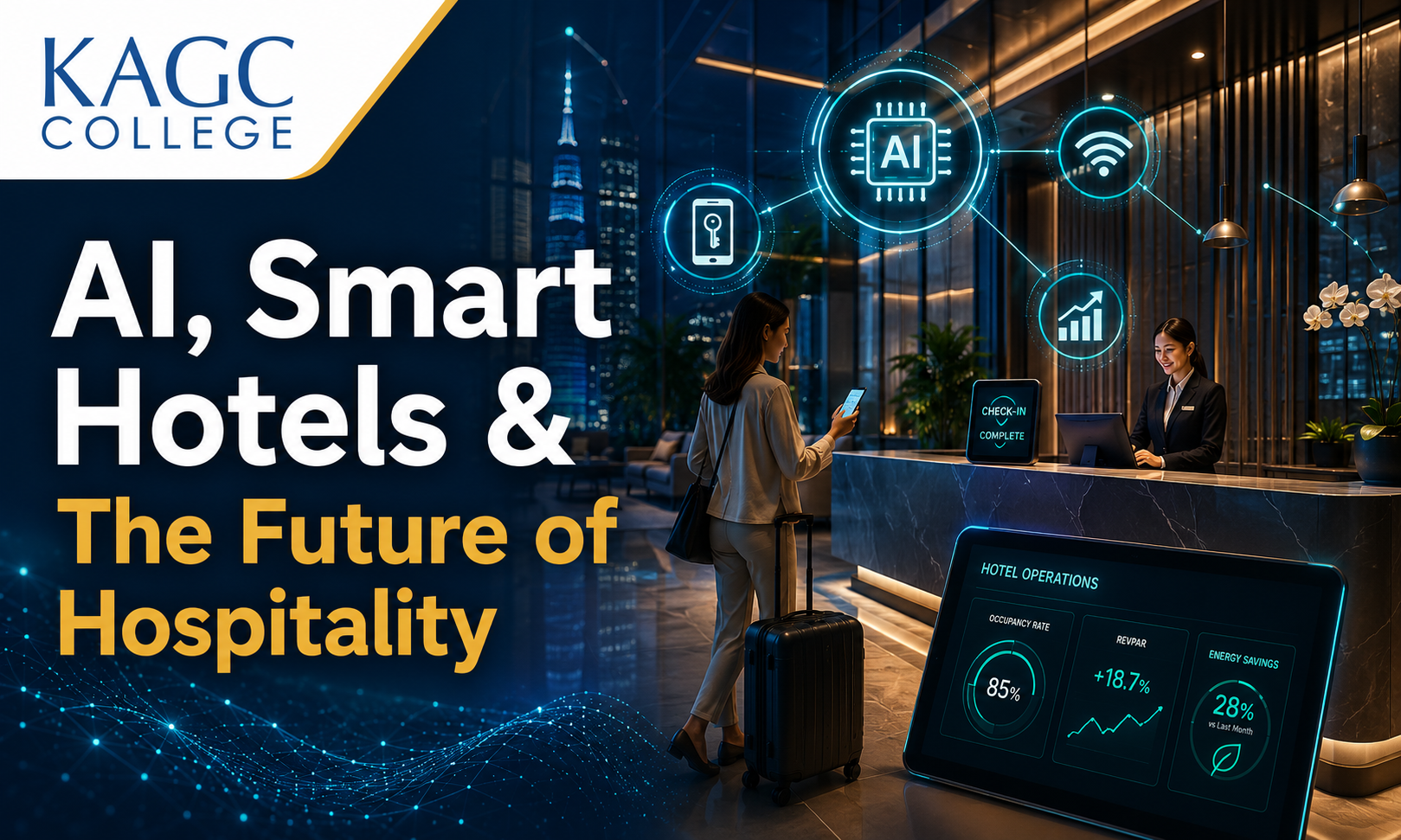
But in the real world of hospitality management Malaysia, the true AI revolution isn’t happening in the lobby—it is happening quietly under the hood of the business.
As the Visit Malaysia 2026 campaign draws millions of global travelers to landmarks like the new Park Hyatt at Merdeka 118 or premium resorts on the Desaru Coast, local hotel owners are facing a triple threat: severe labor shortages, rising operating costs, and hyper-demanding guest expectations. To survive and scale, the industry is shifting from a hands-on labor model to an AI-driven digital framework.
If you want to study hospitality and tourism management, understanding how to wield these predictive and automated tools is what will transform you from a standard graduate into a highly sought-after industry leader.

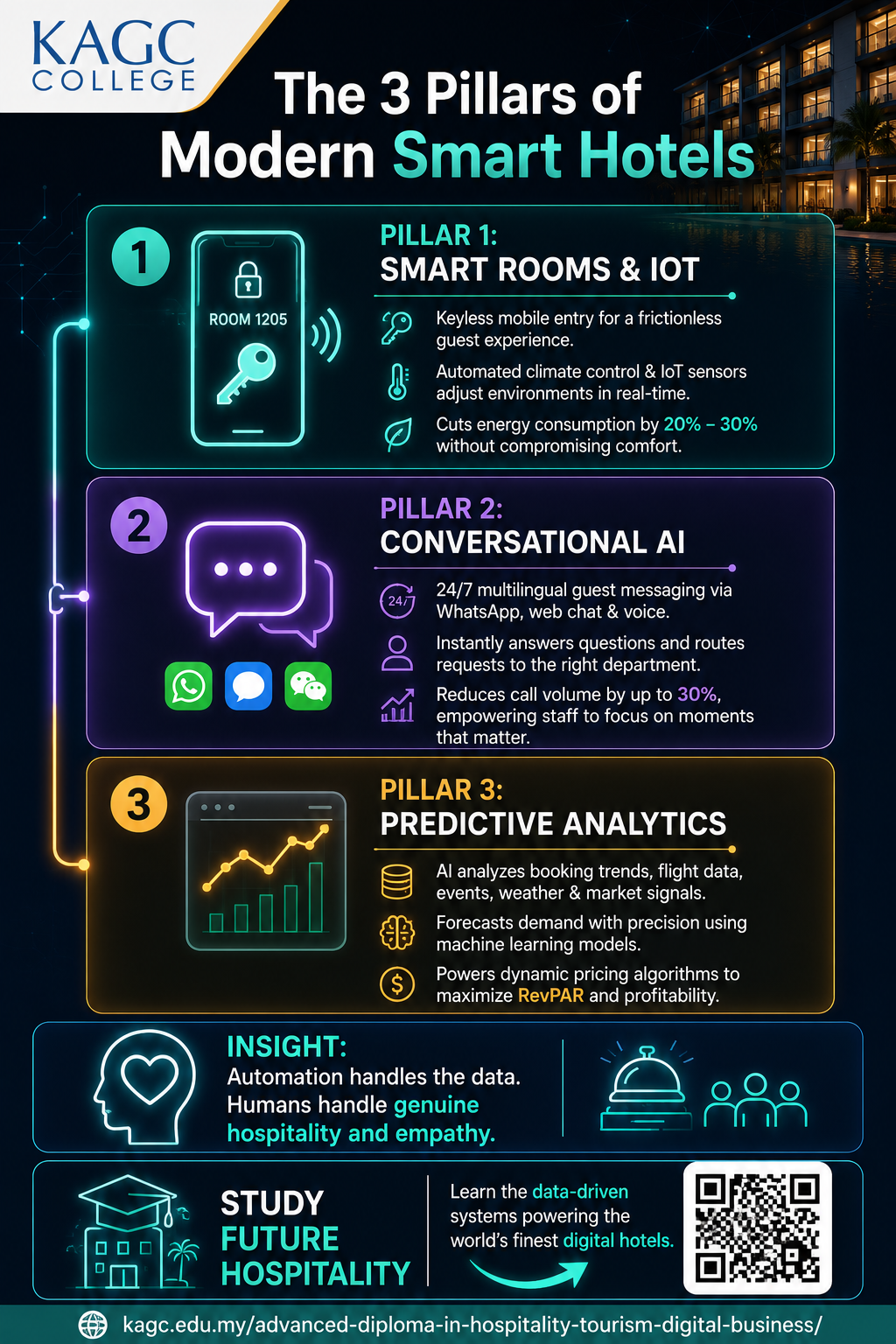
The 3 Pillars of Modern Smart Hotel Infrastructure
The integration of advanced tech into the tourism ecosystem generally falls into three core operational zones.
1. Smart Rooms & IoT (Internet of Things)
Modern properties are moving toward “Smart Rooms 2.0.” Instead of relying on static fixtures, rooms are equipped with IoT sensors that communicate with a centralized Cloud Property Management System (PMS).
- Keyless & Frictionless Entry: Guests bypass the front desk entirely, checking in via a mobile app that activates a digital room key on their smartphone.
- Intelligent Climate & Energy Control: Smart HVAC sensors detect when a room is empty, automatically dipping the temperature and shutting off lighting. According to the International Energy Agency, this simple automation slashes hotel electricity bills by 20% to 30% without sacrificing a sliver of guest comfort.
- Predictive Memory: When a repeat guest returns, the room automatically adjusts to their preferred lighting ambiance, room temperature, and even their preferred espresso strength.
 2. Conversational AI & The Back-Office Revolution
In Malaysia, travelers live on messaging apps like WhatsApp. AI concierge assistants are now deployed to handle routine inquiries in multiple languages (including English, Bahasa Malaysia, and Mandarin) around the clock.
For example, if a guest messages at 2:00 AM asking “What time does the infinity pool close?” or “Can I get an extra pillow?”, an AI assistant resolves the query or routes the work order to housekeeping in under 30 seconds. This slashes call volume by up to 30%, allowing human staff to focus on moments that require genuine empathy and hospitality.
Behind the scenes, agentic AI systems handle data hygiene, automatically auditing supplier bills, tracking utility surges, and reconciling Online Travel Agency (OTA) payouts to prevent revenue leakage long before the end of the financial year.
3. Predictive Analytics & Dynamic Pricing
Predictive analytics platforms act as a hotel’s crystal ball. By sweeping through massive datasets—including historical booking patterns, flight arrival data, local concert schedules, and even real-time weather changes—AI engines forecast room demand with pinpoint accuracy.
This directly feeds into dynamic pricing algorithms. Instead of fixed seasonal rates, room prices adjust mathematically every few minutes to optimize Revenue Per Available Room (RevPAR), allowing hotels to capture maximum profit during high-demand peaks and attract budget-conscious travelers during lulls.
Traditional Operations vs. AI-Driven Smart Hotels
| Operational Focus | Traditional Hotel Framework | AI-Driven Smart Hotel Ecosystem |
| Guest Check-In | Long queues at the reception desk during peak hours. | Mobile check-in, facial recognition, and instant digital keys. |
| Room Pricing | Static, manual pricing updates based on seasonal calendars. | Real-time dynamic pricing updates driven by market algorithms. |
| Maintenance | Reactive (fixing an air conditioner after a guest complains). | Predictive (IoT sensors flagging equipment anomalies before failure). |
| Staffing | Fixed shift schedules that lead to overstaffing or severe burnout. | Predictive scheduling based on live arrival and demand forecasts. |
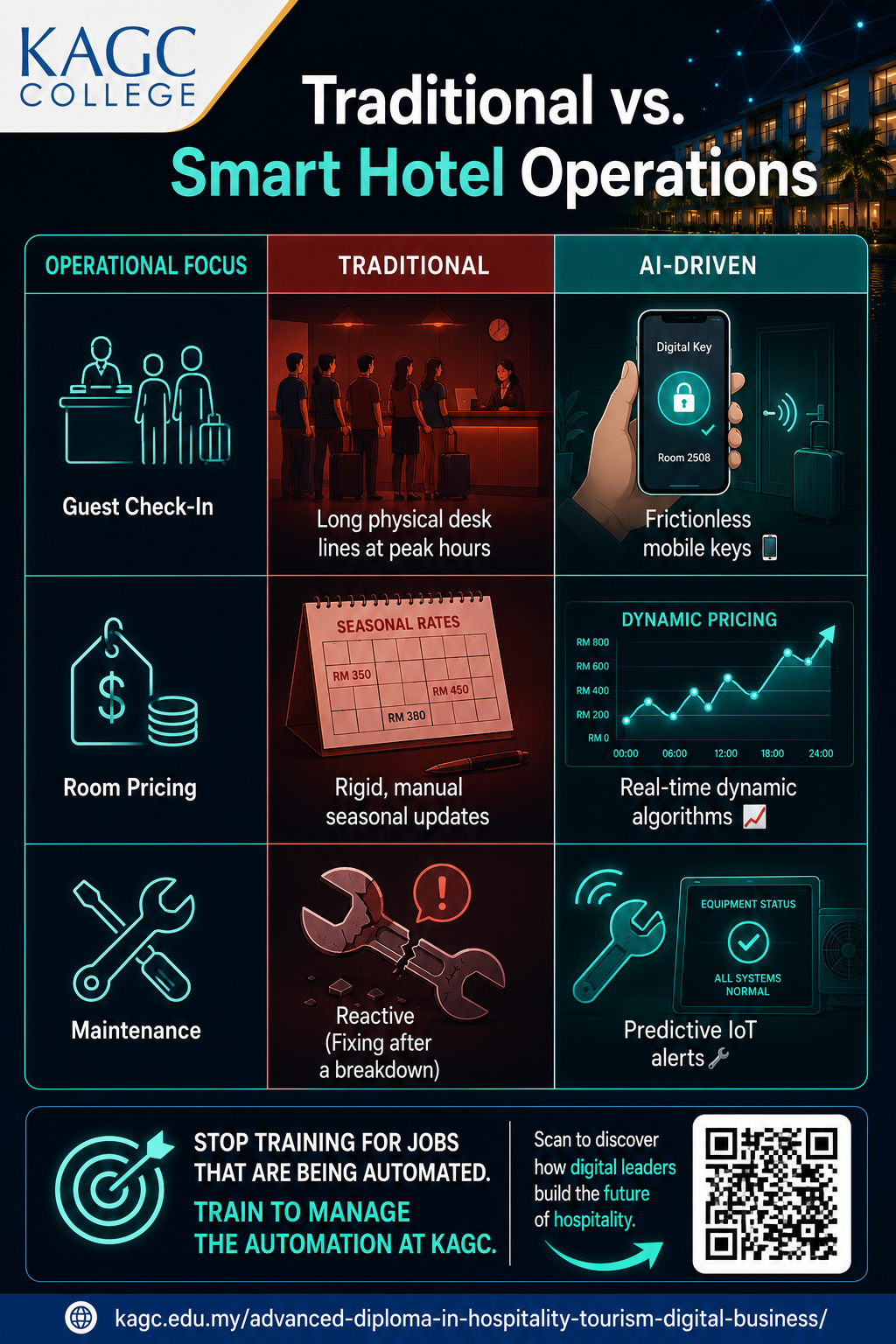
Don’t Just Witness the Future—Lead It with KAGC
The data is clear: properties utilizing AI-first operations report up to 40% efficiency gains and direct 10% to 15% lifts in RevPAR. However, the global hospitality sector faces a massive bottleneck—a severe shortage of talent who actually understand how to implement and manage these digital ecosystems.
This is precisely why KAGC College designed the Advanced Diploma in Hospitality & Tourism Digital Business.
Instead of traditional hospitality courses that train you solely for manual, service-based roles, our forward-thinking digital business course includes dedicated modules like Global Tourism Trends & Future Hospitality. Here, you will learn the strategic execution of automation, digital business metrics, and AI integration.
The Fast Track to Digital Management
- 70% Practical Learning: Learn by analyzing real-world hospitality tech dashboards, building predictive business models, and mapping out automated customer journeys.
- 15-Month Fast-Track: Complete 9 months of high-impact classroom education combined with 6 months of real-world Industry On-the-Job Training (OJT).
- UK-Endorsed Credentials: Graduate with an internationally recognized qualification awarded by the City College of Birmingham, giving you immediate career mobility across global smart hotel chains and travel-tech platforms.
The hospitality sector has evolved into a high-tech digital ecosystem. Don’t train for a job that is being automated away—train to manage the automation itself.
Explore More Hospitality & Tourism Digital Business Resources
Interested in learning more about the profession?