Advanced Diploma in Hospitality & Tourism Digital Business
Lead Hospitality Beyond Service. Drive Growth Through Digital Business.

The hospitality and tourism industry has changed.
Hotels, resorts, attractions and tourism businesses no longer compete solely through excellent service. They compete through digital marketing, online bookings, guest experience, customer loyalty, revenue optimisation and data-driven decision making.
The Advanced Diploma in Hospitality & Tourism Digital Business prepares you to become a modern hospitality professional who understands both business operations and digital growth strategies.
Graduate job-ready in just 15 months with practical industry experience and internationally recognised qualifications.
Graduate in just 15 months with:
- UK Advanced Diploma endorsed by City College of Birmingham
- 9 Months Practical Hospitality & Digital Business Training
- 6-Month Industry On-the-Job Training (OJT)
- Hospitality, Tourism & Digital Marketing Integration
- Revenue Management & Business Analytics Skills
- Career Opportunities in Hotels, Tourism, Events & Digital Business

Hospitality Is No Longer Just About Customer Service
Many people assume hospitality careers revolve around hotel reception, food service, or front office operations.
Today’s hospitality industry is very different.
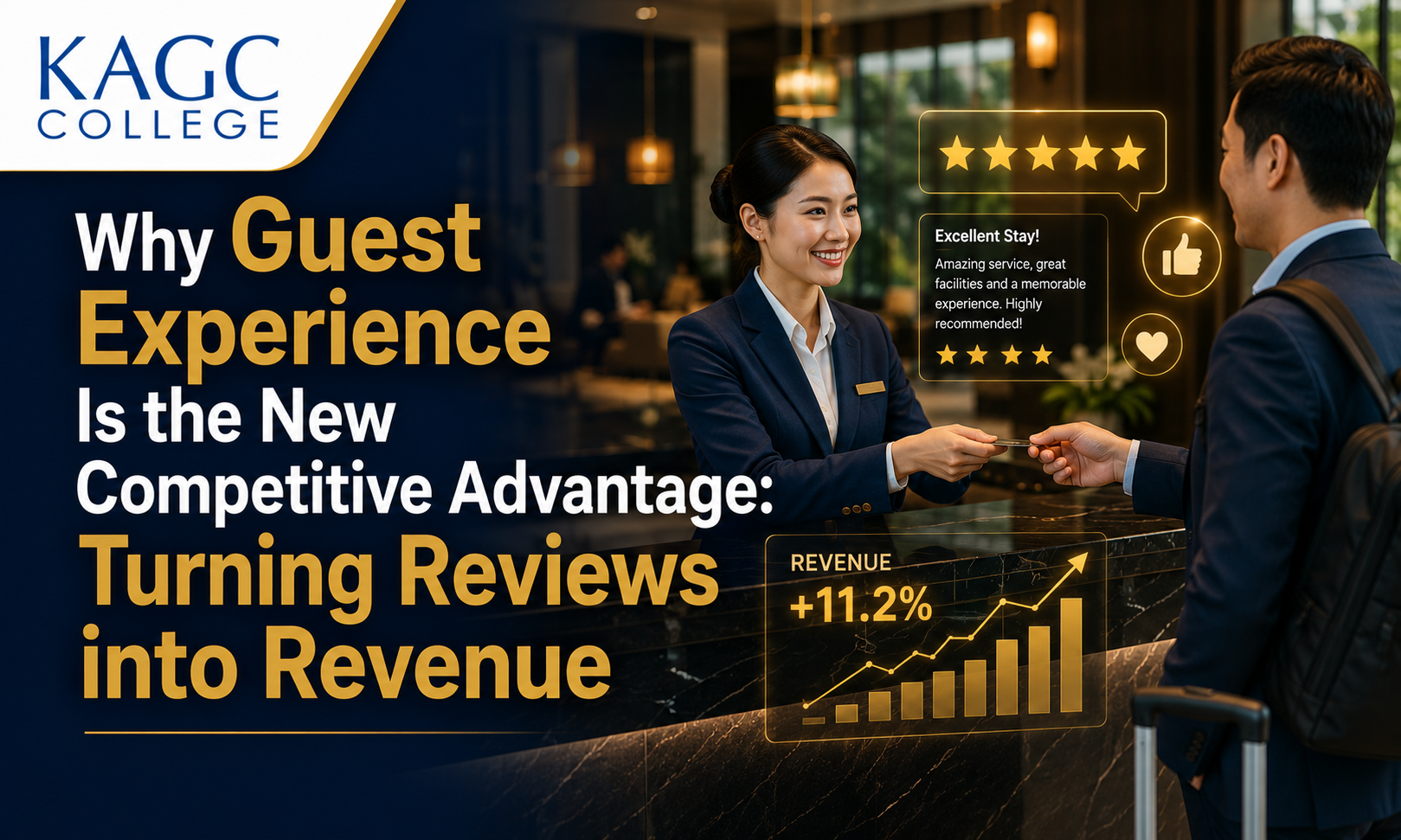
Hotels compete on online visibility. Tourism businesses rely on digital marketing. Guest satisfaction is measured through online reviews. Revenue is driven by occupancy optimisation, pricing strategies, customer data, and digital customer acquisition.
Employers are looking for professionals who understand how hospitality businesses generate revenue—not simply how they operate.
This programme develops graduates who combine hospitality expertise with digital business capabilities, preparing them to contribute to business growth from day one.
Why Parents and Students Choose KAGC
The hospitality industry increasingly demands graduates who possess practical business skills alongside service excellence.
KAGC prepares learners to become commercially minded professionals capable of managing guest experiences, improving business performance, attracting customers, and supporting organisational growth.
Graduates benefit from:
- Internationally Recognised UK Advanced Diploma
- Industry-Focused Practical Learning
- Hospitality + Tourism + Digital Business Integration
- Six Months Industry OJT
- Business Portfolio Development
- Career-Ready Professional Skills
Program Highlights
Duration
15 Months (9 Months In-Class + 6 Months Industry OJT)
Learning Approach
70% Practical Learning
30% Theory
Qualification
UK Advanced Diploma (City College of Birmingham)
Medium
English & Mandarin
About The Programme
Hospitality has become one of the world's fastest-changing industries.
Digital transformation, artificial intelligence, online travel agencies (OTAs), social media, customer analytics and changing traveller behaviour have reshaped how hospitality businesses operate.
This programme develops graduates capable of managing:
- Hospitality Operations
- Tourism Businesses
- Guest Experience
- Events & Conferences
- Hospitality Finance
- Revenue Management
- Digital Marketing
- Search Engine Marketing
- Customer Analytics
- Business Development
Rather than producing operational employees, KAGC prepares future hospitality business professionals capable of improving organisational performance.
Who Should Apply?
✔ SPM Leavers
✔ Students interested in Hospitality & Tourism
✔ Future Hotel Managers
✔ Future Tourism Professionals
✔ Aspiring Event Managers
✔ Students interested in Digital Marketing
✔ Individuals planning to start hospitality businesses
✔ Career changers seeking opportunities in hospitality
Course Format & Features
✓ 15-Month Fast-Track Programme
✓ 9 Months Classroom Learning
✓ 6 Months Industry OJT
✓ 70% Practical Learning
✓ No Hospitality Experience Required
✓ Business & Revenue Management Focus
✓ Professional Portfolio Development
✓ English & Mandarin Medium
What Does 70% Practical Learning Mean?
Students learn by solving real business challenges rather than memorising theory.
Hospitality Operations
Analyse hotel departments, operational workflows, occupancy performance and service quality improvements.
Tourism Business Management
Develop tourism products, destination strategies and visitor experience plans.
Events & Conferences
Plan conferences, exhibitions, corporate events and tourism programmes from concept through execution.
Guest Experience
Design customer journeys, service recovery plans, loyalty programmes and CRM strategies.
Digital Business
Execute SEO projects, Google Ads campaigns, social media marketing and content marketing for hospitality businesses.
Business Analytics
Use Google Analytics, hospitality KPIs, dashboards and revenue reports to improve business decisions.
Industry OJT
Spend six months applying your skills in hotels, tourism organisations or hospitality businesses before graduation.
What Will You Learn?
| Focus | Key Learning Areas |
|---|---|
| Hospitality Operations | Hotel departments, SOPs, occupancy, service quality |
| Tourism Management | Destination development, tourism products, visitor markets |
| Events Management | Conferences, MICE, event planning |
| Guest Experience | Customer journey, CRM, service recovery |
| Digital Marketing | Social Media, SEO, SEM, Content Marketing |
| Business Analytics | KPIs, dashboards, Google Analytics |
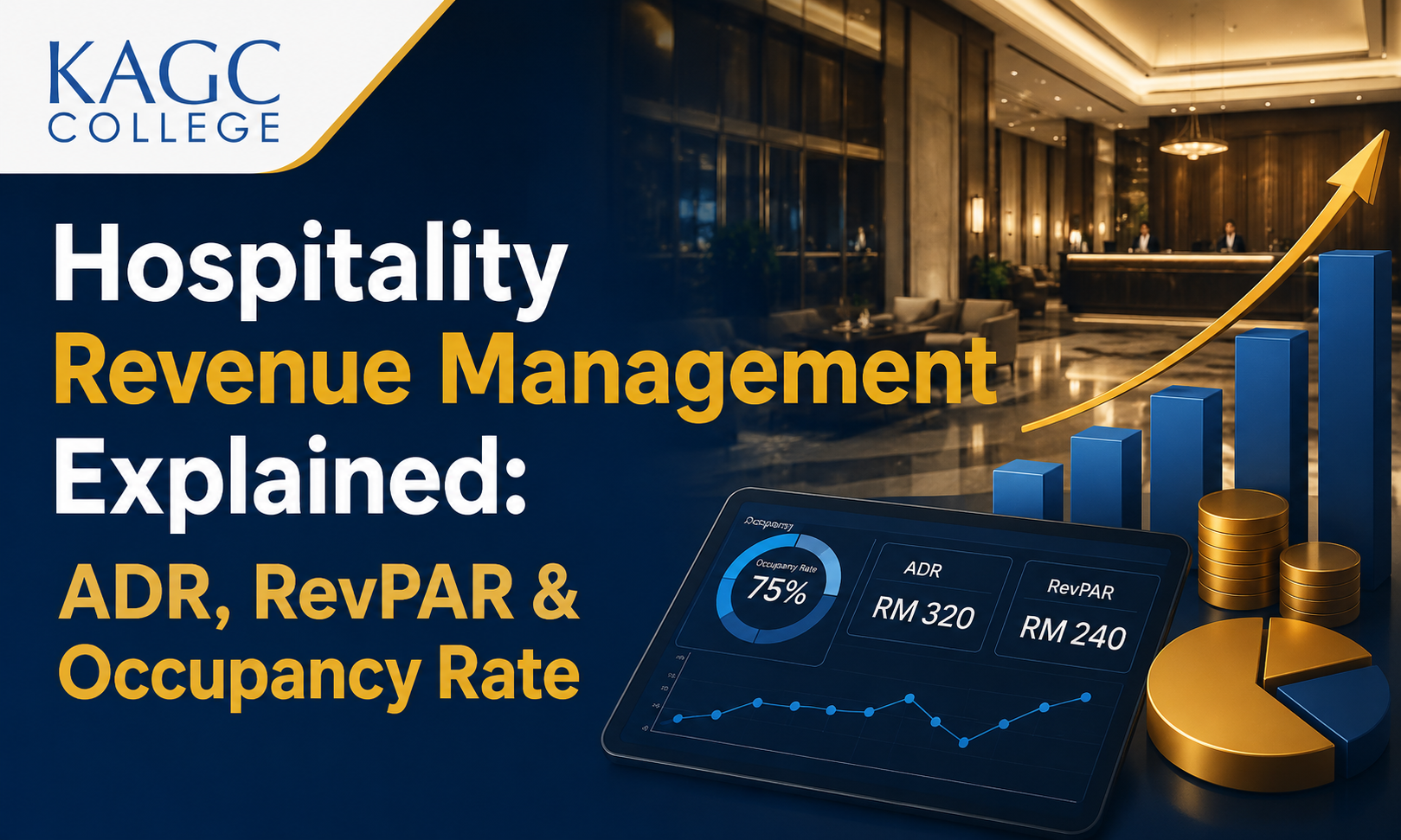
| Hospitality Finance | ADR, RevPAR, budgeting, pricing |
| Leadership | Team management, communication |
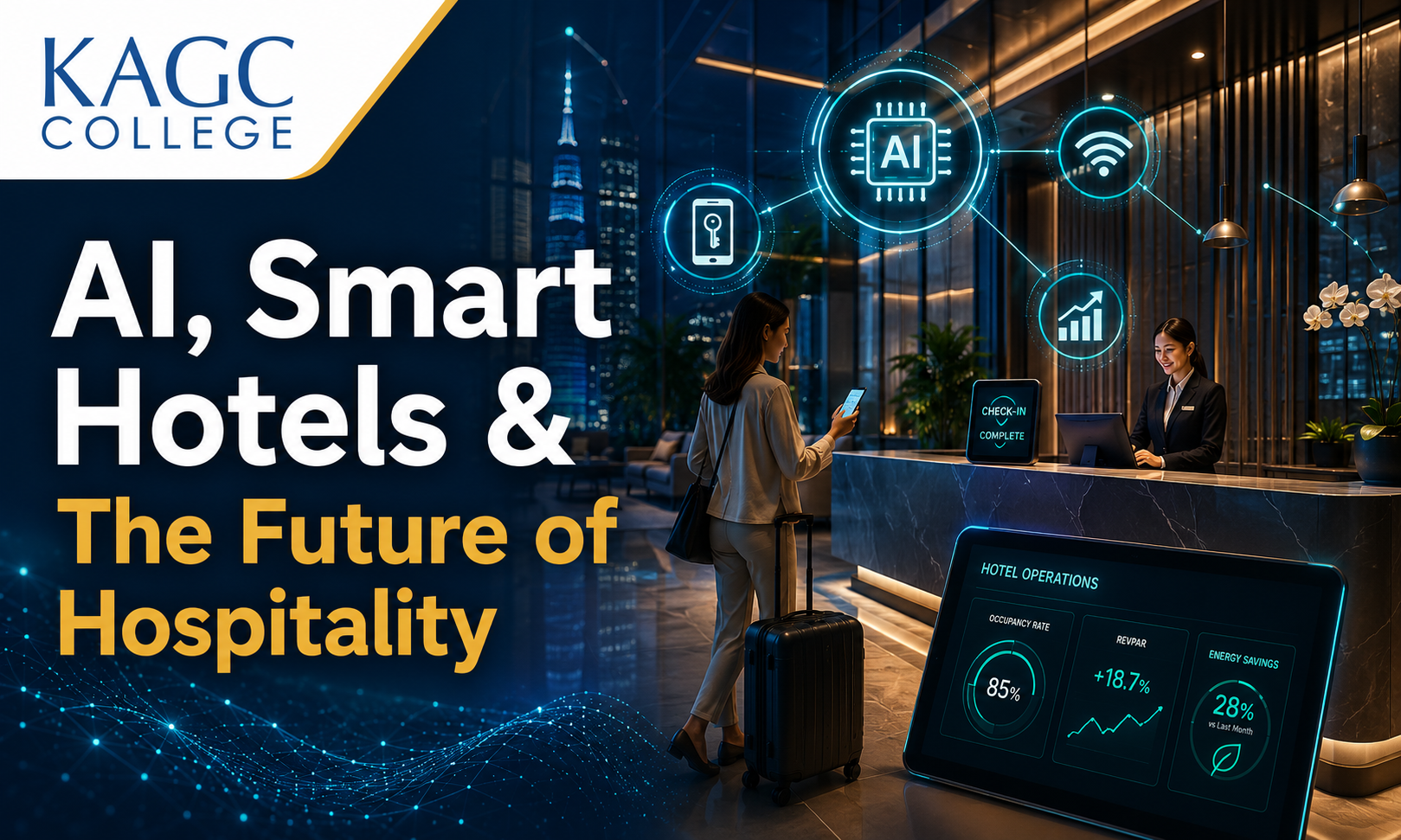
| Future Hospitality | AI, sustainability, digital transformation |
Hospitality Careers Have Changed
Hospitality organisations increasingly recruit professionals who understand customer acquisition, revenue management and digital business.
Graduates are prepared for careers including:
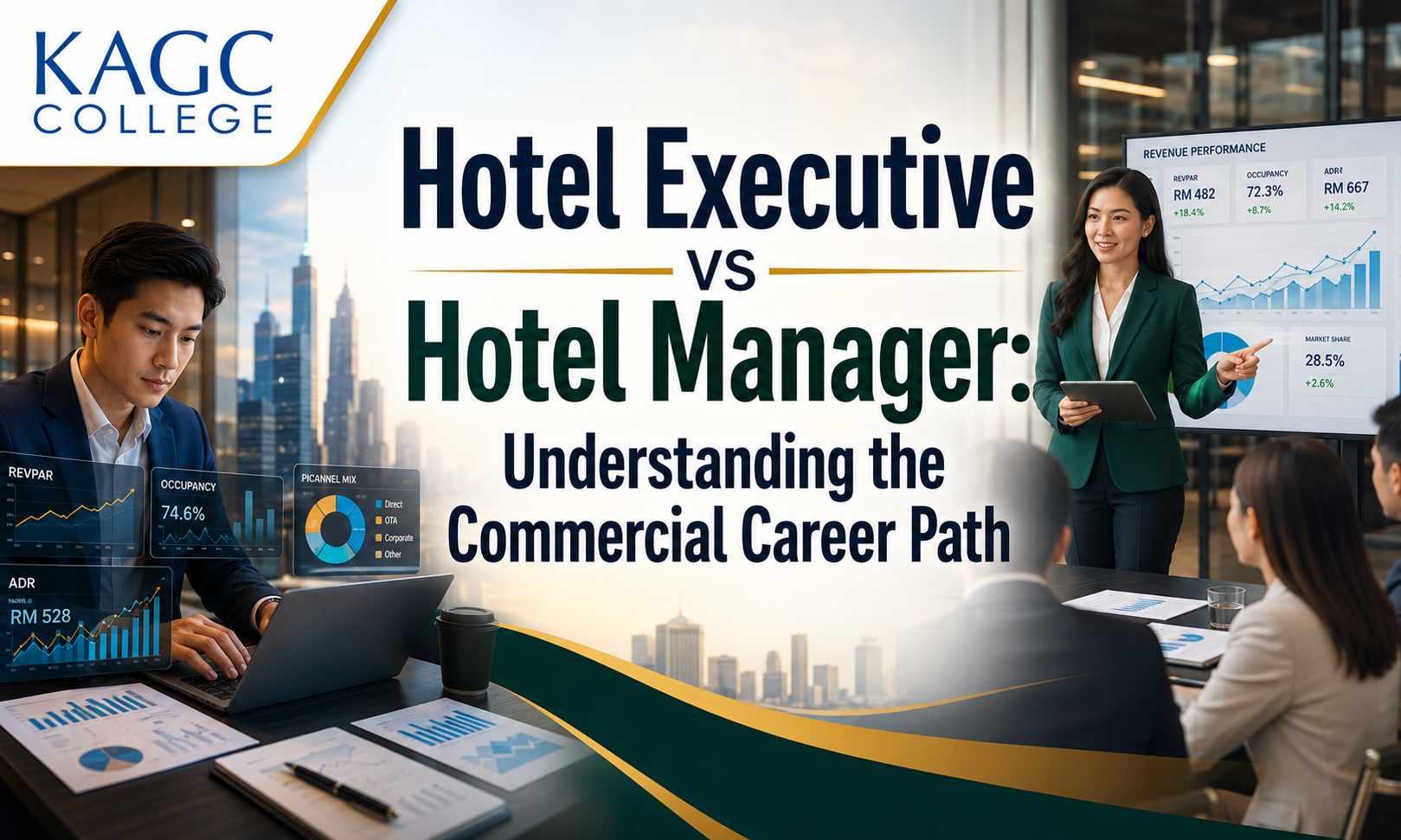
- Hotel Executive
- Revenue Executive
- Guest Experience Executive
- Hospitality Marketing Executive
- Hospitality Sales Executive
- Tourism Executive
- Destination Development Executive
- Events Executive
- Digital Business Executive
- Business Development Executive
- Tourism Product Executive
- Hospitality Entrepreneur
Industry Opportunities
Graduates may pursue opportunities with:










WHY KAGC’S ADVANCED DIPLOMA IN HOSPITALITY & TOURISM DIGITAL BUSINESS?
Hospitality and tourism are no longer only about serving guests.
Today, hotels, resorts, attractions, travel companies, event organisers, and tourism businesses need people who understand how to attract customers, increase bookings, improve guest experience, manage revenue, use digital platforms, analyse business performance, and lead teams.
That is why KAGC’s Advanced Diploma in Hospitality & Tourism Digital Business is designed differently from a traditional hospitality management course.
Instead of preparing students only for service-based roles, this programme develops students to understand the business side of hospitality and tourism. It is suitable for students who are interested in hospitality management, tourism management, hotel management, travel and tourism, events, guest experience, digital marketing, or business development.
If you enjoy working with people, travel, hotels, events, or customer experiences — but you also want a stronger career pathway in business, management, marketing, revenue, or entrepreneurship — this programme gives you a more future-ready route into the industry.
Learn Hospitality as a Business, Not Just as a Service Industry
Many students enter hospitality because they enjoy people, service, travel, hotels, or events. These are good starting points, but long-term career growth depends on more than service attitude alone.
To move into supervisory, executive, management, marketing, revenue, or business development roles, students need to understand how hospitality and tourism businesses actually grow.
At KAGC, students are trained to think beyond daily operations by asking business-focused questions such as:
- How does a hotel increase occupancy?
- How can a tourism destination attract more visitors?
- How do events generate revenue for hotels and tourism businesses?
- How does digital marketing influence bookings?
- How can guest reviews affect business performance?
- How do businesses use data to improve customer experience?
- How can pricing, cost control, and revenue management improve profitability?
This is the major difference between learning “how to work in hospitality” and learning “how to grow a hospitality or tourism business.”
A Future-Ready Combination: Hospitality, Tourism and Digital Business
KAGC’s programme brings together three important areas that are often taught separately:
1. Hospitality Business Management
Students learn how hotels, resorts, food and beverage businesses, accommodation providers, and service organisations operate. This includes service processes, department coordination, operational standards, guest satisfaction, cost control, and business performance.
2. Tourism and Events Management
Students learn how tourism destinations, travel businesses, attractions, conferences, exhibitions, and tourism-related events are planned, promoted, managed, and improved.
3. Digital Business and Customer Acquisition
Students learn how hospitality and tourism businesses use digital platforms to attract customers. This includes social media marketing, content marketing, search engine optimisation, search engine marketing, digital analytics, and marketing performance measurement.
This combination reflects the actual direction of the industry. Modern hospitality and tourism businesses now compete through online visibility, digital campaigns, customer reviews, booking platforms, guest data, pricing strategies, and personalised experiences.
The programme specification confirms that learners develop competencies across hospitality operations, tourism management, guest experience, events, financial management, leadership, digital marketing, SEO, SEM, content marketing, and business analytics.
Build Business Acumen for Stronger Career Mobility
A service-only pathway may help students enter the industry, but it can limit their future progression if they do not develop commercial and management skills.
KAGC’s Advanced Diploma helps students build broader career mobility by developing skills that are relevant across hotels, resorts, tourism organisations, events companies, travel businesses, attractions, online travel platforms, and hospitality-related enterprises.
Students are prepared for career pathways such as:
- Hotel Executive
- Guest Experience Executive
- Tourism Executive
- Events Executive
- Hospitality Sales Executive
- Hospitality Marketing Executive
- Revenue Executive
- Business Development Executive
- Digital Business Executive
- Destination Development Executive
- Tourism Product Executive
- Hospitality Entrepreneur
This makes the programme suitable not only for students who search for a hospitality management course or tourism management course, but also for those exploring business, marketing, travel, events, customer experience, and entrepreneurship.
The qualification document identifies progression opportunities into operational, supervisory, customer experience, business development, marketing, commercial, management, entrepreneurial, and further study pathways.
Learn Revenue Thinking, Not Just Service Thinking
Excellent service is important, but hospitality businesses must also remain profitable.
That is why KAGC students are introduced to business and revenue concepts that help them understand how hospitality and tourism organisations measure success.
Students learn to work with ideas such as:
- Occupancy rate
- ADR, or Average Daily Rate
- RevPAR, or Revenue Per Available Room
- Guest satisfaction
- Customer lifetime value
- Marketing performance
- Cost control
- Profit margin
- Campaign conversion
- Revenue growth
These concepts are especially important for students who want to move into hotel management, hospitality sales, revenue management, digital marketing, events, tourism development, or business leadership.
Instead of seeing hospitality only as a service job, students begin to see it as a business ecosystem where customer experience, marketing, pricing, operations, finance, and leadership must work together.
Practical Learning Through Projects, Simulations and OJT
KAGC’s learning approach is practical and career-focused.
Students do not only memorise theories. They apply what they learn through assignments, case studies, business proposals, campaign planning, simulations, reports, presentations, and practical projects.
Learning experiences may include:
- Analysing hotel operations
- Creating tourism destination proposals
- Planning events and conferences
- Mapping guest journeys
- Developing service recovery strategies
- Creating social media campaigns
- Planning SEO and SEM strategies
- Analysing hospitality business metrics
- Preparing financial and revenue recommendations
- Evaluating future hospitality trends
The programme uses assignment and project-based assessments across its units, allowing students to demonstrate workplace-relevant competencies through realistic tasks.
After completing 9 months of in-class learning, students will complete 6 months of On-the-Job Training, giving them the opportunity to apply their skills in real hospitality or tourism environments before graduation.
Academic Partner
Earn a UK Advanced Diploma Endorsed by City College of Birmingham
KAGC’s Advanced Diploma in Hospitality & Tourism Digital Business is academically endorsed by City College of Birmingham, giving students the opportunity to graduate with a UK-endorsed qualification while studying through KAGC’s practical, industry-focused learning model.
Upon successful completion, students will receive the Level 4 Advanced Diploma in Hospitality & Tourism Digital Business issued by City College of Birmingham. The qualification carries 120 credits, with a total qualification time of 1,200 hours.
This academic endorsement strengthens the programme’s value because students are not only gaining practical exposure; they are also completing a structured UK Level 4 qualification designed to support employment, entrepreneurship, and future academic progression.
Why the City College of Birmingham Endorsement Matters
For parents and students, choosing a hospitality or tourism programme is not only about choosing a place to study. It is about choosing a qualification that can support long-term career and academic growth.
The City College of Birmingham endorsement gives the programme a clear academic structure while KAGC delivers the learning through a practical, applied, and industry-relevant approach.
This means students gain both:
A UK-endorsed academic qualification
and
practical skills for the modern hospitality and tourism industry
This is especially important for students who want to enter the industry quickly, but still want a qualification that keeps future study and career progression open.
A Qualification Designed for the Modern Hospitality Economy
The hospitality and tourism industry is being reshaped by digital transformation, artificial intelligence, online travel agencies, customer reviews, sustainability expectations, changing traveller behaviour, and data-driven decision making.
The City College of Birmingham-endorsed qualification reflects this shift by combining hospitality and tourism management with digital business capabilities.
Students study areas such as:
- Hospitality Business Operations
- Tourism Business & Destination Management
- Events and Conferences Management
- Guest Experience Management
- People Leadership & Team Performance
- Hospitality Financial Management
- Global Tourism Trends & Future Hospitality
- Social Media Marketing
- Content Marketing
- Search Engine Optimisation
- Search Engine Marketing
- Digital Business & Marketing Metrics & Analytics
This makes the programme more relevant for students who want to pursue hospitality management, tourism management, hotel management, events management, hospitality marketing, revenue management, digital business, or entrepreneurship.
What This Means for KAGC Students
By choosing KAGC’s Advanced Diploma in Hospitality & Tourism Digital Business, students gain:
- A UK-endorsed Level 4 Advanced Diploma
- 9 months of in-class practical learning
- 6 months of industry On-the-Job Training
- Exposure to hospitality, tourism, events, digital marketing, analytics, finance, and leadership
- A stronger understanding of business acumen, not only service delivery
- Career pathways across hotels, tourism, events, digital business, sales, marketing, revenue, and entrepreneurship
- A foundation for further studies in hospitality, tourism, business, digital business, or related fields
This makes KAGC a strong choice for students who are interested in the hospitality and tourism industry but want a programme that prepares them for the future business direction of the sector.
STUDY FINANCIAL SUPPORT
Education is an important investment for every family.
As this programme does not include SKM certification, PTPK funding is not applicable. However, KAGC provides flexible study financing support to help students and parents manage their education investment more comfortably.
Available support includes:
- Flexible payment plans
- Monthly instalment options
- Structured payment arrangements
- Admissions consultation for families
Parents and students are encouraged to speak with KAGC’s Admissions Team to explore the most suitable payment arrangement.
Entry Requirements
Minimum Requirements
✓ Minimum age: 16 years old
✓ Completed SPM or equivalent qualification
✓ School leavers and working adults are welcome
Intake
January
May
July
October
Required Documents
✓ KAGC College Application Form
✓ Photocopy of NRIC of the student (front & back)
✓ A certified photocopy of SPM and/or school leaving certificate
✓ A copy of a passport-size photo on white background
✓ A certified copy of your previous qualification to claim for exemption (if applicable)
Frequently Asked Questions
What is the Advanced Diploma in Hospitality & Tourism Digital Business?
The Advanced Diploma in Hospitality & Tourism Digital Business is a 15-month programme that combines hospitality management, tourism management, digital marketing, business analytics, guest experience, revenue management, leadership, and industry training.
It is designed for students who want to enter the hospitality and tourism industry with stronger business knowledge, not just service skills. Students learn how hotels, resorts, tourism businesses, events companies, and travel organisations attract customers, improve guest experience, increase bookings, manage revenue, and grow through digital platforms.
Is this a hospitality management course or a tourism management course?
How is this programme different from a traditional hospitality management diploma?
Traditional hospitality programmes often focus mainly on operations such as front office, housekeeping, food and beverage, and guest service.
KAGC’s programme goes further by adding digital business and commercial skills such as:
- Social media marketing
- Content marketing
- SEO
- SEM / Google Ads
- Business analytics
- Guest experience management
- Hospitality financial management
- Revenue-related decision making
- Events and conferences management
- Tourism business and destination management
This helps students understand how hospitality and tourism businesses make money, attract customers, and remain competitive in the digital economy.
Why should I study Hospitality & Tourism Digital Business instead of general business?
General business programmes teach broad business concepts, but they may not focus deeply on the hospitality and tourism industry.
This programme applies business knowledge directly to real hospitality and tourism contexts, such as hotels, resorts, travel companies, attractions, events, online booking platforms, tourism destinations, and guest experience management.
Students who enjoy travel, hotels, events, tourism, customer experience, or service industries may find this programme more relevant than a general business diploma.
Why is digital business important in hospitality and tourism?
Hospitality and tourism businesses now depend heavily on digital platforms.
Travellers often search online, compare hotels, read reviews, watch social media content, use booking platforms, and respond to digital advertisements before making decisions.
That means modern hospitality professionals need to understand:
- How customers search for hotels and destinations
- How digital marketing influences bookings
- How online reviews affect trust
- How Google Ads and SEO support visibility
- How customer data improves decision making
- How social media builds demand
- How online travel agencies affect revenue
This programme prepares students for that digital shift.
Is this programme only for students who want to work in hotels?
No.
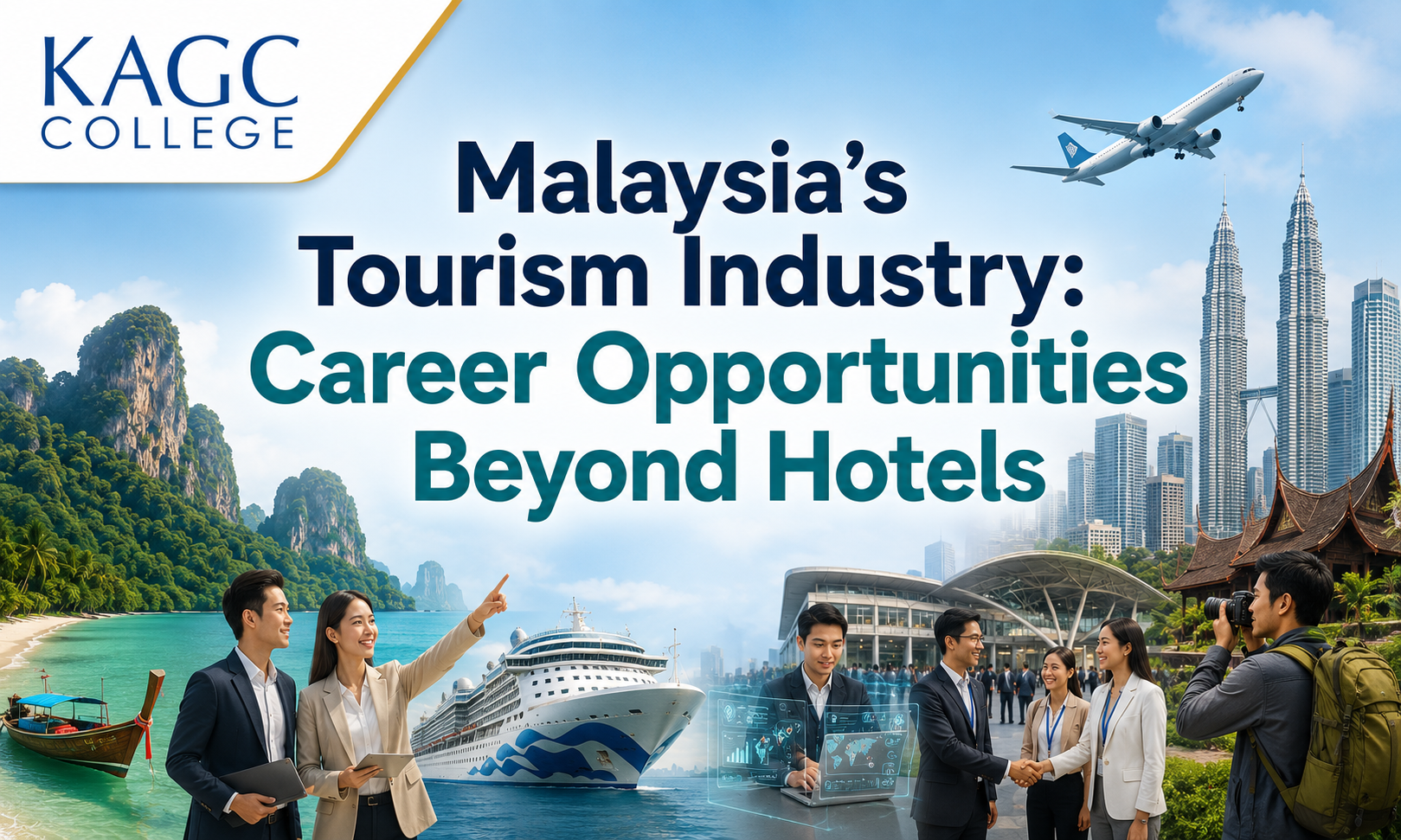
Although hotel careers are one pathway, graduates may also explore opportunities in tourism, events, travel, attractions, destination management, digital business, hospitality sales, marketing, guest experience, and entrepreneurship.
The programme is suitable for students interested in the wider hospitality and tourism ecosystem, not only hotel operations.
Where can I work after graduating?
Graduates may work in:
- Hotels and resorts
- Travel agencies
- Tourism organisations
- Event management companies
- Convention centres
- Theme parks and attractions
- Airlines and cruise-related businesses
- Destination management companies
- Hospitality sales and marketing departments
- Online travel platforms
- Hospitality technology companies
- Tourism product development companies
- Hospitality and tourism start-ups
This gives students a wider career pathway than a service-only hospitality qualification.
What jobs can I apply for after completing this programme?
Graduates may pursue roles such as:
- Hotel Executive
- Guest Experience Executive
- Tourism Executive
- Events Executive
- Hospitality Sales Executive
- Hospitality Marketing Executive
- Revenue Executive
- Business Development Executive
- Digital Business Executive
- Destination Development Executive
- Tourism Product Executive
- Customer Experience Executive
- Hospitality Entrepreneur
The qualification document states that graduates may progress into employment in operational, supervisory, customer experience, business development, marketing, commercial, and management-related roles.
Will this programme help me become a hotel manager?
Yes, this programme can support your pathway toward hotel management, but graduates normally build experience progressively.
Students begin by developing knowledge in hotel operations, guest experience, leadership, finance, revenue thinking, and digital business. These skills are useful for long-term progression into supervisory and management roles.
Instead of only learning how hotel departments function, students also learn how hospitality businesses improve customer satisfaction, control costs, manage revenue, and attract customers.
Is this programme suitable for someone interested in tourism management?
Is this programme suitable for someone interested in events?
- Corporate events
- Conferences
- Exhibitions
- MICE tourism
- Product launches
- Festivals
- Tourism-related events
- Hotel event departments
Will I learn digital marketing in this programme?
Yes.
Students learn digital marketing skills that are relevant to hospitality and tourism businesses, including:
- Social Media Marketing
- Content Marketing
- Search Engine Optimisation
- Search Engine Marketing
- Digital Business & Marketing Metrics & Analytics
These modules help students understand how businesses use digital channels to attract travellers, promote destinations, improve visibility, generate leads, and measure campaign performance.
Will I learn Google Ads, SEO, and social media marketing?
Yes.
Students are introduced to SEO, SEM, social media marketing, content marketing, and digital analytics as part of the digital business component.
These skills are especially useful in hospitality and tourism because customers often search online before choosing hotels, destinations, attractions, events, or travel services.
Will I learn about AI and the future of hospitality?
What is guest experience management?
Guest experience management is the process of designing, managing, and improving every stage of a customer’s interaction with a hospitality or tourism business.
This includes:
- Online discovery
- Booking experience
- Arrival experience
- Service touchpoints
- Complaint handling
- Personalised service
- Online reviews
- Loyalty programmes
- Post-visit communication
Students learn how guest experience affects customer satisfaction, repeat visits, online reputation, and business performance.
What is revenue management in hospitality?
Revenue management is the process of helping hotels and hospitality businesses maximise income through pricing, occupancy, demand forecasting, and business performance analysis.
Students are introduced to concepts such as:
- Occupancy rate
- ADR, or Average Daily Rate
- RevPAR, or Revenue Per Available Room
- Pricing strategy
- Demand patterns
- Cost control
- Profitability
These concepts help students understand the business side of hospitality, not just service delivery.
Will I learn hospitality finance?
Yes.
The programme includes Hospitality Financial Management, where students learn budgeting, cost control, pricing, financial performance, revenue management, and hospitality-related business indicators.
This is important because future hospitality professionals must understand how operational decisions affect profitability.
Is this programme practical or theory-based?
The programme is designed to be practical and industry-relevant.
Students learn through assignments, projects, case studies, simulations, reports, presentations, and workplace-related tasks. The assessment approach focuses on assignment and project-based learning rather than relying only on exams.
This helps students build a portfolio of work that demonstrates practical competencies.
Is there On-the-Job Training?
- 9 months of in-class learning
- 6 months of On-the-Job Training
Why is the 6-month OJT important?
The 6-month OJT gives students real workplace exposure before graduation.
It helps students:
- Understand actual industry expectations
- Build confidence in a professional environment
- Apply hospitality and tourism knowledge
- Develop communication and teamwork skills
- Build a stronger resume
- Explore career interests
- Improve employability after graduation
For parents, OJT is important because it helps reduce the gap between classroom learning and real employment.
Is this programme suitable for SPM leavers?
Yes, the programme is suitable for school leavers who are interested in hospitality, tourism, events, travel, business, digital marketing, or customer experience.
Students who do not want a purely theory-based route may find this programme more practical because it combines classroom learning, business projects, and industry training.
Is this programme suitable for students who are not sure what career they want yet?
Yes.
This programme is suitable for students who have a general interest in travel, hotels, tourism, events, people, business, marketing, or customer experience but have not decided on one specific career.
Because the curriculum covers multiple areas, students can explore different pathways before choosing their future direction.
Do I need previous hospitality experience to join this programme?
No.
The programme is designed to build students from foundation level towards business, management, digital, and industry-ready competencies.
Students do not need prior hospitality experience, although interest in people, service, travel, events, or business will be helpful.
Is this programme suitable for introverted students?
Yes.
Hospitality and tourism are people-centred industries, but not every role requires students to be highly extroverted.
Students who are more analytical or business-minded may be suited for roles in:
- Revenue management
- Digital marketing
- SEO
- Content planning
- Business analytics
- Event planning
- Tourism product development
- Operations coordination
- Guest experience analysis
This programme is not only for students who want front-facing service roles.
Is hospitality still a good career choice?
Yes, hospitality and tourism continue to offer career opportunities because people travel, attend events, dine out, visit attractions, stay in hotels, and seek experiences.
However, the industry is changing. Employers increasingly need people who understand digital platforms, customer data, guest experience, sustainability, revenue, and business growth.
That is why a future-ready hospitality programme should include business and digital skills, not only service training.
What kind of student is best suited for this programme?
This programme is suitable for students who:
- Enjoy travel, hotels, tourism, events, or customer experience
- Prefer practical learning
- Want a business-focused career
- Are interested in digital marketing
- Like working with people
- Want international career exposure
- Are interested in entrepreneurship
- Want to enter the workforce with practical skills
It is also suitable for students who may not want a traditional academic route but still want a structured qualification with career progression.
Can I work overseas after completing this programme?
The programme provides a UK-endorsed Advanced Diploma and industry-relevant skills that may support international career opportunities.
However, overseas employment depends on each country’s visa rules, employer requirements, work experience, language ability, and local regulations.
Students who aim to work overseas should use the programme as a foundation and continue building experience, communication skills, and professional networks.
Can I continue to a degree after this programme?
Yes.
The qualification document states that graduates may progress to higher-level qualifications in hospitality management, tourism management, business management, digital business, or related disciplines, subject to institutional entry requirements.
Students should confirm specific degree pathways and credit transfer options with KAGC’s academic team or the receiving institution.
Is this a UK qualification?
Yes.
Successful learners will receive the Level 4 Advanced Diploma in Hospitality & Tourism Digital Business issued by City College of Birmingham. The qualification carries 120 credits.
Who is the academic partner for this programme?
Does this programme include SKM?
No.
This programme does not include SKM certification. It is a UK-endorsed Advanced Diploma programme.
Because it does not include SKM, PTPK funding is not applicable.
Is PTPK funding available for this programme?
No.
PTPK funding is not available for this programme because it does not include SKM certification.
Parents and students may speak with KAGC’s Admissions Team about available flexible payment arrangements.
What financing options are available?
KAGC provides flexible study financing support, which may include:
- Monthly instalment options
- Structured payment arrangements
- Admissions consultation for families
Students and parents are encouraged to speak with KAGC’s Admissions Team for the most suitable payment plan.
What subjects will I study?
Students study a mix of hospitality, tourism, digital business, leadership, finance, law, and future industry modules.
Key areas include:
- Social Media Marketing
- Content Marketing
- SEO
- SEM
- Digital Business & Marketing Metrics & Analytics
- Hospitality Business Operations
- Tourism Business & Destination Management
- Events and Conferences Management
- Guest Experience Management
- People Leadership & Team Performance
- Hospitality Financial Management
- Global Tourism Trends & Future Hospitality
- Microeconomics
- Business Laws
These units are listed in the qualification structure.
Will I learn business law and economics?
Will I learn leadership skills?
Is this programme only for students who like customer service?
No.
Customer service is part of hospitality, but this programme is broader.
It is also suitable for students interested in:
- Business management
- Digital marketing
- Tourism development
- Event planning
- Hotel revenue
- Guest experience strategy
- Sales and marketing
- Data and analytics
- Entrepreneurship
The programme helps students understand hospitality as a business ecosystem, not only a service job.
Can I become an entrepreneur after this programme?
Yes.
The programme includes business, finance, marketing, tourism, events, digital business, and leadership knowledge that can support future entrepreneurship.
Graduates may consider starting businesses such as:
- Boutique accommodation
- Homestay business
- Travel services
- Tourism experience packages
- Event planning services
- Hospitality marketing agency
- Guest experience consultancy
- Food, beverage, or lifestyle tourism business
Entrepreneurship success will still depend on business planning, experience, capital, market demand, and execution.
Why should parents consider this programme for their child?
Parents should consider this programme because it prepares students for a broader future than traditional service-based hospitality training.
Students learn practical and business-relevant skills, including hospitality operations, tourism management, digital marketing, guest experience, events, finance, revenue thinking, analytics, and leadership.
The 6-month OJT also helps students gain real workplace exposure before graduation.
Why should students choose KAGC for hospitality and tourism?
Students should choose KAGC if they want a practical, business-focused hospitality and tourism programme that prepares them for the digital future of the industry.
KAGC’s programme helps students understand not only how hospitality businesses serve guests, but also how they attract customers, manage experiences, increase revenue, use digital platforms, analyse performance, and grow.
Is KAGC’s Advanced Diploma in Hospitality & Tourism Digital Business a good choice for students interested in hospitality or tourism?
Yes. KAGC’s Advanced Diploma in Hospitality & Tourism Digital Business is a strong choice for students interested in hospitality management, tourism management, hotel management, travel and tourism, events, guest experience, digital marketing, business development, and hospitality entrepreneurship. The programme combines hospitality operations, tourism management, digital business, SEO, SEM, social media marketing, guest experience, revenue management, leadership, and 6 months of On-the-Job Training (OJT). It prepares students to understand the business side of hospitality and tourism, not only service operations.