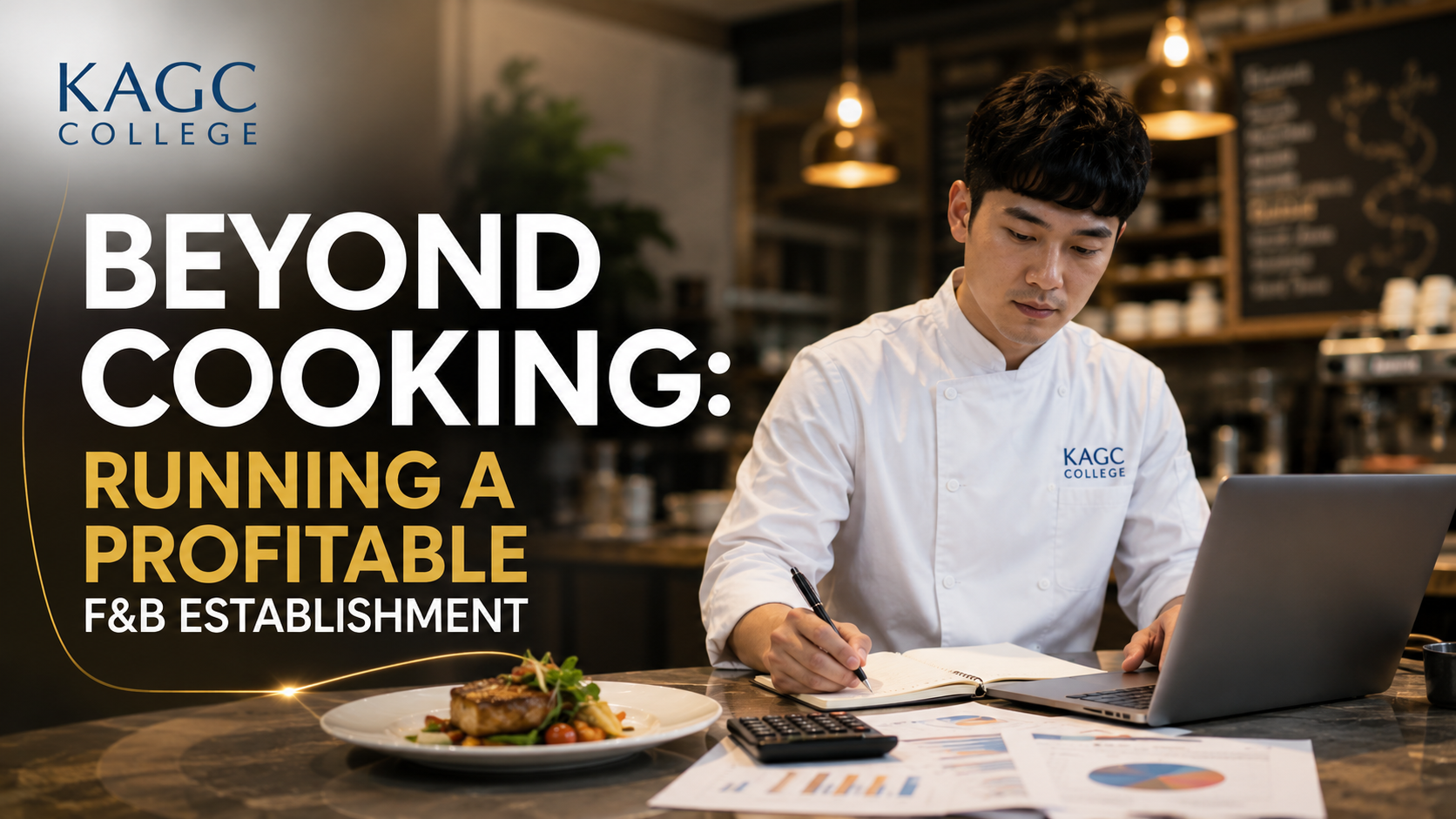


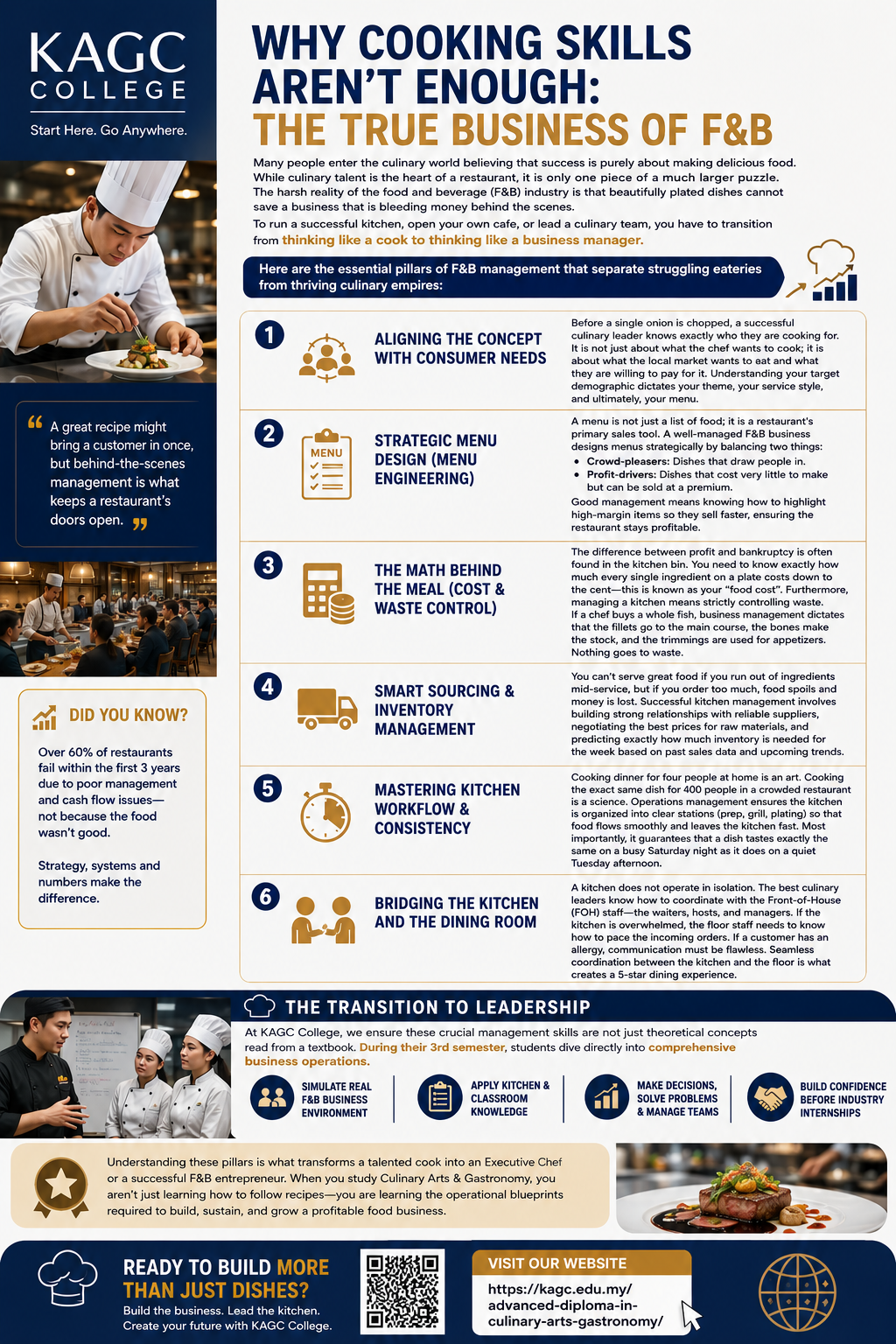
Why Cooking Skills Aren’t Enough: The True Business of F&B
The Skills That Separate a Kitchen Employee from a Culinary Leader.
Many people dream of opening a successful café, running a thriving restaurant, becoming an Executive Chef, or even launching their own food brand.
Most assume the journey begins and ends with one thing:
Learning how to cook.
While cooking is undoubtedly the foundation of every culinary career, it is only one part of a much larger equation.
Every year, thousands of talented cooks enter the hospitality industry with excellent culinary skills. Yet many never progress beyond operational kitchen roles. Some eventually leave the industry altogether, while others struggle when attempting to manage a restaurant or start a food business.
The reason is surprisingly simple:
Restaurants do not succeed because of food alone.
Restaurants succeed when great food is supported by strong business management.
The ability to create a delicious dish may attract customers once.
The ability to manage costs, maintain consistency, lead teams, and deliver profitable operations is what keeps customers returning and businesses thriving.
This is why the most successful culinary professionals understand not only how to cook—but also how to run a business.
Why Great Food Alone Doesn’t Guarantee Success
Many aspiring chefs believe that creating amazing food is the key to restaurant success.
While food quality is essential, history has shown that many restaurants serving excellent food still fail.
Industry studies consistently identify common reasons why food businesses struggle:
- Poor cost control
- Weak inventory management
- Inefficient operations
- Inconsistent customer experience
- Labour management issues
- Cash flow problems
- Poor menu planning
Notice that none of these challenges are directly related to cooking ability.
A restaurant can serve exceptional food and still lose money if operational systems are poorly managed.
This reality explains why hospitality employers increasingly value business and management skills alongside culinary expertise.
The Difference Between a Cook and a Culinary Leader
Many people use the terms “cook” and “chef” interchangeably.
In reality, they represent very different levels of responsibility.
A Cook Focuses on Execution
Responsibilities typically include:
- Preparing ingredients
- Following recipes
- Cooking food
- Maintaining workstation cleanliness
- Supporting kitchen operations
A Chef Focuses on Leadership
Responsibilities often include:
- Managing kitchen teams
- Controlling food costs
- Designing menus
- Purchasing ingredients
- Managing inventory
- Maintaining profitability
- Training staff
- Ensuring operational efficiency
As professionals move up the culinary career ladder, their responsibilities become increasingly focused on management rather than cooking alone.
This is why culinary leadership requires a broader skill set than technical culinary ability.
The Science of Menu Engineering
One of the most valuable business skills in the hospitality industry is menu engineering.
Menu engineering is the process of analysing menu items based on their popularity and profitability.
Many restaurant owners assume their best-selling dishes generate the highest profits.
Often, the opposite is true.
A dish may sell frequently but generate very little profit after accounting for ingredient costs, preparation time, and wastage.
Through menu engineering, businesses can identify:
- High-profit dishes
- Low-profit items
- Customer favourites
- Underperforming products
- Pricing opportunities
These insights allow businesses to optimise menus and improve profitability without necessarily increasing customer prices.
For modern culinary leaders, menu development is both a creative and financial exercise.
Understanding Food Costing: The Numbers Behind Every Dish
One of the biggest mistakes new restaurant owners make is focusing on sales instead of profit.
A restaurant may generate high revenue yet remain unprofitable if food costs are poorly controlled.
Food costing involves calculating:
- Ingredient costs
- Portion sizes
- Yield percentages
- Preparation losses
- Food wastage
For example, a dish selling for RM30 may appear profitable.
However, if ingredient costs, wastage, and preparation expenses are too high, the actual profit margin may be significantly lower than expected.
Understanding food costing helps culinary professionals:
- Set appropriate menu prices
- Maintain profit margins
- Reduce unnecessary waste
- Improve purchasing decisions
This skill is one of the most important competencies required by Executive Chefs and F&B Managers.
Inventory Management: Controlling What You Cannot See
Inventory represents one of the largest operating costs for restaurants and hospitality businesses.
Poor inventory management can lead to:
- Food spoilage
- Over-ordering
- Stock shortages
- Theft
- Increased operational costs
Successful culinary leaders understand how to monitor stock levels, forecast demand, and ensure ingredients are available when needed without creating excessive waste.
Effective inventory management improves:
- Cost efficiency
- Operational consistency
- Cash flow management
- Customer satisfaction
For businesses operating on tight margins, inventory control can be the difference between profitability and financial loss.
Labour Management and Team Leadership
A restaurant’s success depends heavily on the people working within it.
Even the best systems can fail without effective leadership.
As culinary professionals advance into senior positions, they become responsible for:
- Staff scheduling
- Team motivation
- Performance management
- Conflict resolution
- Training and development
Managing people is often more challenging than managing food.
Strong leadership helps create:
- Consistent service quality
- Higher employee retention
- Improved workplace culture
- Better customer experiences
This is one reason why Executive Chefs are valued not only for their culinary expertise but also for their ability to lead teams effectively.
Customer Experience Is Everyone’s Responsibility
Many kitchen professionals assume customer service is the responsibility of front-of-house staff.
In reality, customer experience begins in the kitchen.
Factors such as:
- Food quality
- Presentation consistency
- Order accuracy
- Service speed
- Menu design
all influence how customers perceive a business.
Modern hospitality organisations increasingly encourage collaboration between kitchen and service teams to ensure a seamless guest experience.
Understanding customer expectations helps culinary professionals contribute to the overall success of the business.
Why Hospitality Employers Value Business Skills
Today’s hospitality employers seek more than technically competent cooks.
They need professionals who understand how their decisions affect profitability, operations, and customer satisfaction.
Employers increasingly value candidates who can contribute to:
Operational Efficiency
Improving workflow and reducing bottlenecks.
Cost Control
Managing food, labour, and operational expenses.
Menu Development
Creating products that satisfy customers while generating profit.
Team Leadership
Building productive and motivated teams.
Business Growth
Supporting long-term organisational success.
These competencies often become deciding factors when promotions and leadership opportunities arise.
The Future Belongs to Culinary Professionals Who Understand Business
The hospitality industry continues to evolve rapidly.
Restaurants face increasing challenges such as:
- Rising food costs
- Labour shortages
- Changing consumer preferences
- Digital transformation
- Greater competition
As a result, culinary professionals who understand both food and business are becoming increasingly valuable.
The future leaders of the industry will not simply be the best cooks.
They will be the individuals who can combine:
- Culinary excellence
- Operational knowledge
- Financial understanding
- Leadership capability
- Customer-focused thinking
into a single professional skill set.
How KAGC College Prepares Future Culinary Leaders
KAGC College’s Advanced Diploma in Culinary Arts & Gastronomy is designed to prepare learners for both culinary and business success.
The programme goes beyond teaching cooking techniques.
Students are exposed to:
Culinary Foundations
- Professional cooking techniques
- International cuisines
- Kitchen operations
F&B Business Management
- Food costing
- Menu engineering
- Inventory management
- Procurement and purchasing
Leadership Development
- Team management
- Operational planning
- Workplace professionalism
Industry Experience
- Practical training
- Real-world kitchen exposure
- Structured On-the-Job Training (OJT)
This integrated approach helps learners develop the competencies required to progress beyond operational roles and into future leadership positions.
Success in F&B Requires More Than Passion
Passion may inspire someone to enter the culinary industry.
Cooking skills may secure their first job.
However, long-term success requires a deeper understanding of how food businesses operate.
The most successful chefs are not simply experts in preparing dishes.
They understand profitability.
They understand operations.
They understand people.
And most importantly, they understand that great food is only one ingredient in building a successful hospitality business.
For aspiring culinary professionals, learning the business side of F&B may be the single most important step toward transforming a passion for food into a sustainable and rewarding career.
Frequently Asked Questions (FAQ)
Why do restaurants fail even when the food is good?
Many restaurants struggle due to poor cost control, inventory management, labour planning, operational inefficiencies, and weak financial management rather than food quality alone.
What is menu engineering?
Menu engineering is the process of analysing menu items based on profitability and popularity to optimise restaurant performance and profitability.
Why is food costing important?
Food costing helps businesses determine appropriate selling prices, maintain profit margins, reduce waste, and improve financial performance.
What skills does an Executive Chef need?
Executive Chefs typically require culinary expertise, leadership ability, food costing knowledge, inventory management skills, menu development capabilities, and operational management experience.
Is business knowledge important for chefs?
Yes. As chefs progress into senior positions, business management skills become increasingly important for overseeing kitchen operations, controlling costs, leading teams, and maintaining profitability.
Can a Culinary Arts Diploma help me start my own restaurant?
A comprehensive culinary programme that includes both culinary and business management training can provide valuable knowledge for individuals planning to launch or manage food businesses in the future.
Explore More Culinary Arts & Gastronomy Resources
Interested in learning more about the profession?