


Both May Start at RM1,800, But Their Career Paths Look Very Different 10 Years Later
One of the most common questions asked by students and parents considering a culinary career is:
“Can chefs actually earn a good salary?”
It is a valid concern.
After all, many entry-level kitchen positions in Malaysia offer starting salaries that appear relatively modest. To some families, it may seem difficult to justify investing in culinary education when someone can immediately begin working in a restaurant without formal qualifications.
However, focusing solely on a chef’s starting salary often paints an incomplete picture.
The hospitality industry is not a profession where long-term success is determined by where you begin.
It is determined by how quickly you progress.
The real difference between culinary professionals often emerges years later, when some individuals remain in operational kitchen roles while others advance into supervisory, management, and executive positions.
This is where professional education can significantly influence career growth.
Understanding Entry-Level Chef Salaries in Malaysia
Most culinary professionals begin their careers in entry-level positions such as:
- Kitchen Assistant
- Commis Chef
- Junior Cook
- Demi Chef
- Pastry Assistant
At this stage, employers primarily evaluate practical skills, work attitude, reliability, and willingness to learn.
As a result, starting salaries may not vary dramatically between individuals who possess formal culinary qualifications and those who do not.
This reality often leads some people to conclude that culinary education has little value.
However, the first job is only the beginning of a much longer career journey.
The more important question is:
What happens after the first two, five, or ten years?
Why Career Progression Matters More Than Starting Salary
A chef’s long-term earning potential depends heavily on career progression.
As culinary professionals gain experience, employers increasingly assess them based on competencies that extend far beyond cooking.
Promotion opportunities are often linked to a person’s ability to:
- Manage kitchen operations
- Lead teams
- Control food costs
- Reduce wastage
- Develop menus
- Manage inventory
- Train junior staff
- Improve profitability
These responsibilities become increasingly important as chefs advance into senior positions.
Professionals who possess these skills often progress more rapidly into leadership roles where salaries and responsibilities increase substantially.
A Typical Culinary Career Pathway
The culinary profession offers a structured progression pathway that rewards both experience and competency.
Entry-Level Stage (0–2 Years)
Typical Positions:
- Kitchen Assistant
- Commis Chef
- Demi Chef
- Junior Pastry Chef
Focus Areas:
- Food preparation
- Kitchen operations
- Hygiene and safety
- Technical skills development
At this stage, individuals build foundational culinary skills and learn how professional kitchens operate.
Intermediate Stage (3–5 Years)
Typical Positions:
- Chef de Partie
- Senior Chef de Partie
- Kitchen Supervisor
- Junior Sous Chef
Focus Areas:
- Station management
- Team coordination
- Quality control
- Inventory monitoring
This stage marks the transition from operational execution to supervisory responsibilities.
Advanced Stage (5–8 Years)
Typical Positions:
- Sous Chef
- Executive Sous Chef
- Kitchen Manager
Focus Areas:
- Staff management
- Cost control
- Menu development
- Kitchen productivity
At this level, culinary professionals begin contributing directly to operational performance and profitability.
Leadership Stage (8–15 Years)
Typical Positions:
- Executive Chef
- Culinary Operations Manager
- F&B Manager
- Corporate Chef
Focus Areas:
- Strategic planning
- Financial management
- Team leadership
- Business performance
These positions represent some of the highest-paying and most influential roles within the hospitality industry.
The Difference Between Experience and Structured Learning
Experience is valuable in every profession.
However, relying solely on workplace experience can sometimes slow career progression.
Many kitchen employees learn through observation and repetition.
While this develops practical competence, it may not provide systematic exposure to:
- Food costing
- Menu engineering
- Procurement
- Inventory control
- Financial management
- Leadership development
- Culinary innovation
As a result, some individuals remain highly skilled cooks but struggle to progress into management positions.
Structured culinary education helps address these gaps by providing exposure to the broader competencies required by hospitality employers.
Why Employers Promote Certain Chefs Faster
When hospitality employers evaluate candidates for promotion, technical cooking ability is only one consideration.
Senior positions require individuals who can help businesses operate more efficiently and profitably.
Employers often promote chefs who demonstrate:
Leadership Skills
The ability to manage and motivate teams.
Business Awareness
Understanding how kitchen decisions affect profitability.
Problem-Solving Ability
Resolving operational challenges effectively.
Cost Control Knowledge
Managing food costs and reducing waste.
Communication Skills
Working effectively with management, suppliers, and service teams.
These competencies often determine who progresses into leadership roles and who remains in operational positions.
The Long-Term Financial Impact of Faster Career Progression
A small difference in annual salary growth can produce significant financial outcomes over an entire career.
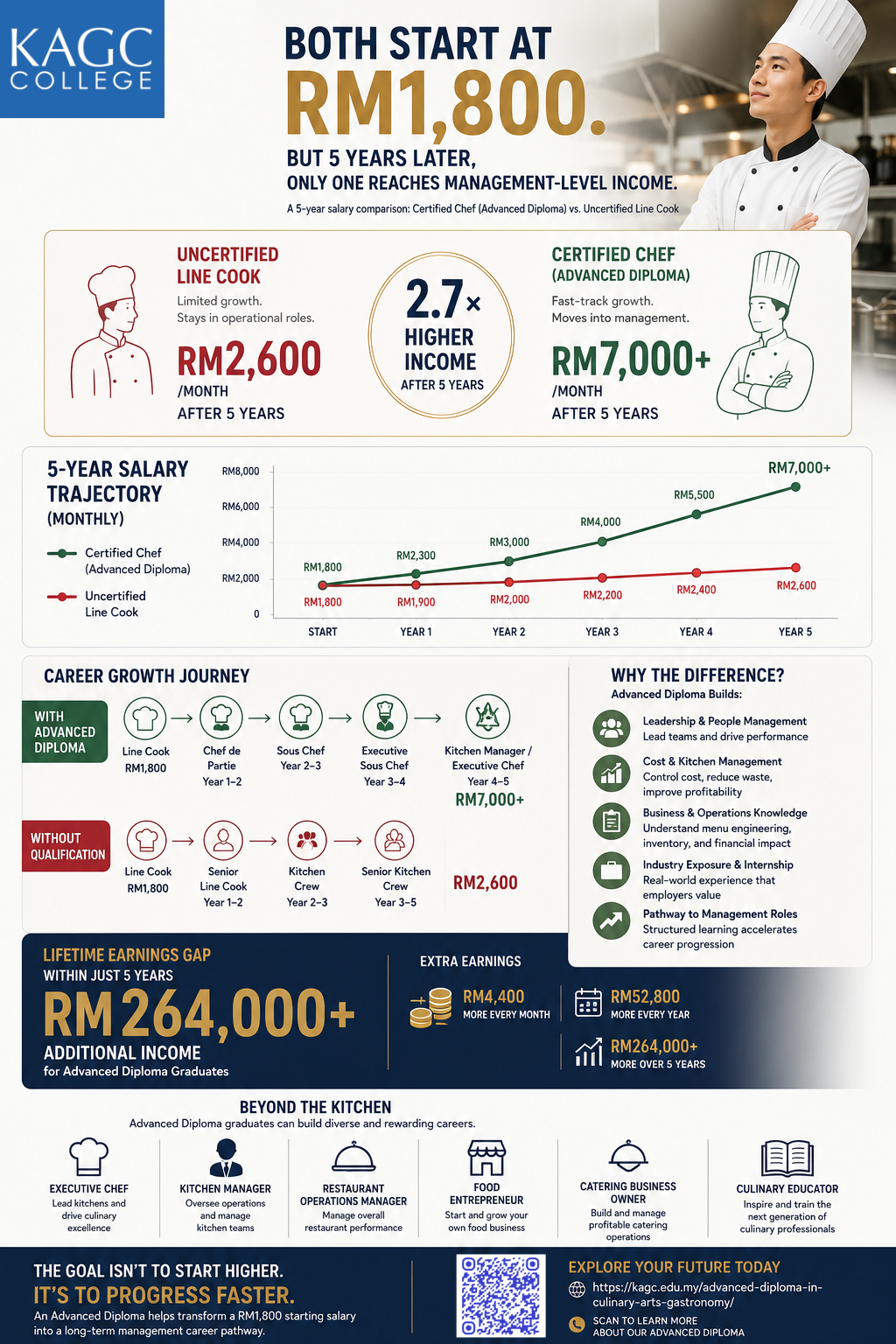
Consider two individuals who begin their careers at similar starting salaries.
One develops broader competencies in culinary operations, leadership, food costing, and business management.
The other focuses primarily on operational cooking tasks.
Over time, the first individual may gain access to promotions and leadership opportunities earlier.
The result is not simply a higher monthly salary.
It can mean:
- Higher cumulative earnings
- Greater job stability
- Improved career mobility
- Access to premium employers
- Opportunities for international employment
Over a 10-year period, these differences can become substantial.
This is why many hospitality professionals evaluate career decisions based on long-term earning potential rather than immediate starting salaries.
Executive Chef: One of the Most Rewarding Culinary Careers
Many aspiring chefs dream of eventually becoming an Executive Chef.
The role extends far beyond cooking.
Executive Chefs are responsible for:
- Leading culinary teams
- Managing budgets
- Developing menus
- Maintaining quality standards
- Overseeing food safety
- Controlling operational costs
- Driving business performance
Because of these responsibilities, Executive Chefs are often among the highest-paid culinary professionals within hospitality organisations.
The journey to this level requires more than technical expertise.
It requires leadership, operational knowledge, and business acumen.
Why Culinary Education Can Accelerate Career Growth
Professional culinary education provides structured exposure to skills that employers increasingly value.
In addition to technical cooking competencies, students often learn:
Culinary Operations
Understanding how professional kitchens function efficiently.
Food Costing
Managing profitability through accurate pricing and portion control.
Menu Engineering
Designing menus that balance customer satisfaction and financial performance.
Inventory Management
Reducing waste and controlling stock levels.
Leadership Development
Preparing for supervisory and management responsibilities.
These competencies can help graduates enter the workforce with a broader understanding of hospitality operations.
As a result, they may be better positioned to pursue advancement opportunities when compared to individuals relying solely on workplace learning.
The Hospitality Industry Needs Future Leaders
Malaysia’s hospitality industry continues to evolve.
Hotels, resorts, restaurants, cafés, cruise operators, and tourism-related businesses increasingly require professionals who can combine culinary expertise with operational understanding.
Employers are not simply looking for cooks.
They are looking for future:
- Sous Chefs
- Executive Chefs
- Kitchen Managers
- Culinary Operations Managers
- F&B Leaders
This shift has increased demand for individuals who possess both technical and business competencies.
How KAGC College Helps Build Long-Term Culinary Careers
KAGC College’s Advanced Diploma in Culinary Arts & Gastronomy is designed to prepare learners for both employment and career progression.
The programme combines:
Advanced Culinary Training
- Classical culinary techniques
- International cuisines
- Professional kitchen operations
Modern Gastronomy
- Culinary innovation
- Molecular gastronomy exposure
- Contemporary food presentation
Business & Management Skills
- Food costing
- Menu engineering
- Inventory management
- Kitchen operations management
Industry Experience
- Extensive practical training
- Real-world culinary exposure
- Structured On-the-Job Training (OJT)
This balanced approach helps learners develop the competencies required for long-term success within the hospitality industry.
The Real Question Isn’t What a Chef Earns Today
Many students focus on what a chef earns during the first year of employment.
While this information is important, it represents only a small part of the story.
The more important question is:
What can a chef earn after five, ten, or fifteen years?
Career growth in hospitality is often determined by the ability to move beyond cooking and into leadership.
Those who develop management, operational, and business skills frequently enjoy greater career opportunities, higher earning potential, and broader professional mobility.
The difference between a kitchen employee and a culinary leader is rarely determined by talent alone.
It is often determined by the knowledge, skills, and preparation that support long-term career progression.
Frequently Asked Questions (FAQ)
What is the average chef salary in Malaysia?
Chef salaries vary depending on experience, employer type, location, and position. Entry-level culinary professionals generally earn less than senior management positions such as Sous Chef, Executive Chef, and F&B Manager.
Can chefs earn a high income in Malaysia?
Yes. Senior culinary professionals working in hotels, resorts, fine dining establishments, and hospitality groups can earn significantly more than entry-level kitchen staff due to their leadership and operational responsibilities.
Does a culinary diploma increase earning potential?
A culinary diploma can help individuals develop technical, operational, and management skills that support career progression into higher-paying positions.
How long does it take to become an Executive Chef?
Career progression varies by individual, employer, and experience level. Many professionals spend several years progressing through positions such as Commis Chef, Chef de Partie, and Sous Chef before reaching Executive Chef roles.
What skills are required to become an Executive Chef?
Executive Chefs typically require culinary expertise, leadership ability, food costing knowledge, inventory management skills, menu development experience, and strong operational understanding.
Is culinary education worth it for career advancement?
For individuals seeking long-term career growth, leadership opportunities, and broader employment options, structured culinary education can provide valuable skills that support faster progression within the hospitality industry.
Explore More Culinary Arts & Gastronomy Resources
Interested in learning more about the profession?